
Introduction
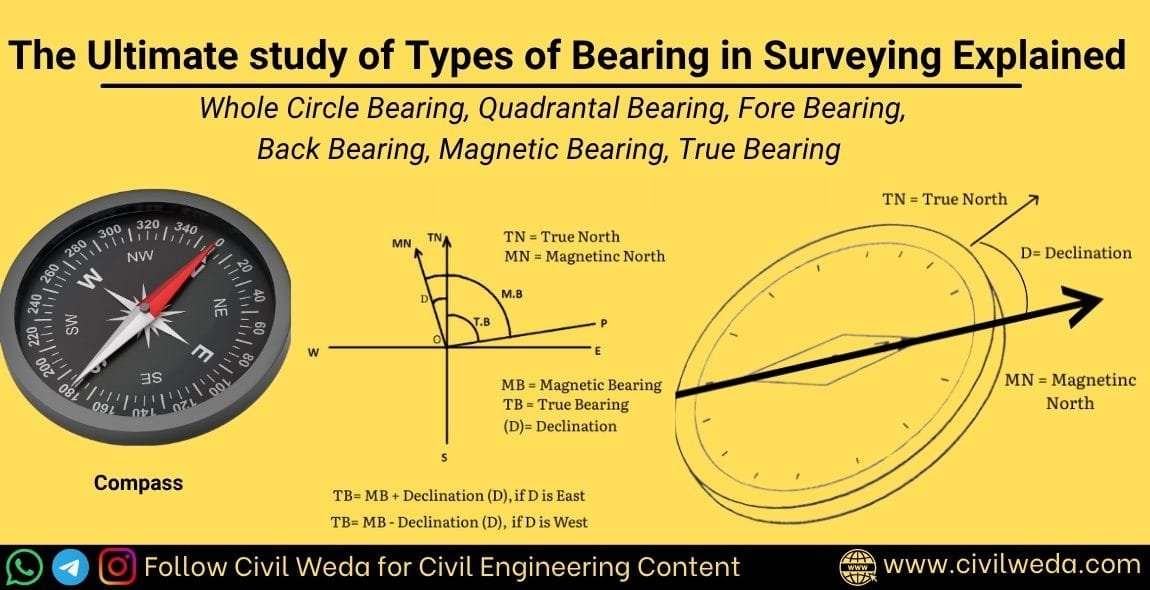
Types of Bearing in Surveying are fundamental concepts that every civil engineering student and field surveyor must understand. Bearings define the horizontal angle of a survey line with respect to a fixed reference direction, usually the north.
A clear knowledge of these bearings is essential for accurate field measurements, preparing precise maps, and avoiding costly errors during surveying projects. Many beginners find it confusing because of the different reference directions and angle measurement systems.
In this article, we will cover all the types of bearings in surveying with simple explanations, neat diagrams, and practical tips to help you master this important topic.
What is Bearing in Surveying?
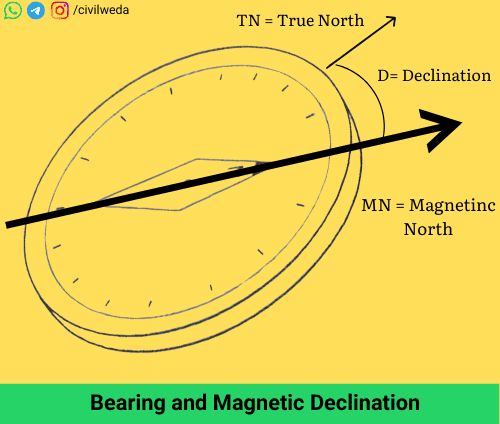
In surveying, bearing is the horizontal angle measured between a survey line and a fixed reference direction, usually the north or south. It helps in locating the direction of a line on the earth’s surface and is essential for preparing accurate maps and field plans. For a detailed background on the concept of bearings in navigation and mapping, you can refer to Wikipedia – Bearing
Bearings are generally measured clockwise using instruments such as a prismatic compass or a theodolite. They provide the direction of one survey point relative to another, which makes it possible to plot lines, boundaries, and positions on a map.
Note: For a complete article on compass-based field surveying work, you can check our detailed post on Compass Survey
A correct understanding of bearing is crucial because even a small error in measuring angles can lead to significant mistakes in the plotted map or construction layout. That’s why learning the types of bearings in surveying is one of the first steps for students and field engineers.
Classification of Bearings in Surveying
The types of bearings in surveying are classified based on the reference direction used and the method of measuring angles. A clear understanding of these classifications is essential for accurate fieldwork and error-free mapping. Below are the main types of bearings in surveying that every civil engineering student and surveyor must know:
Whole Circle Bearing (WCB)
- In the Whole Circle Bearing system, the bearing of a line is measured clockwise from the north direction.
- The angle starts at 0° at the north and increases clockwise up to 360°.
- This system is widely used with a Prismatic Compass and Theodolite because it is simple for calculations.
- Line towards North → WCB = 0° (or 360°)
- Line towards East → WCB = 90°
- Line towards South → WCB = 180°
- Line towards West → WCB = 270°
Whole Circle Bearing (WCB) expresses the direction as a single angle, which makes it convenient for plotting and computation.
Quadrantal Bearing (QB) / Reduced Bearing (RB)
- The Quadrantal Bearing system measures the bearing of a line from either the North or the South towards the East or West, whichever is nearer.
- The angle lies between 0° and 90° in each of the four quadrants.
- Commonly used with a Surveyor’s Compass.
- Line in the northeast direction → N 50° E
- Line in the southwest direction → S 40° W
Quadrantal Bearing (QB) is useful for quick field readings but needs conversion to WCB for mathematical work.
Fore Bearing (FB) and Back Bearing (BB)
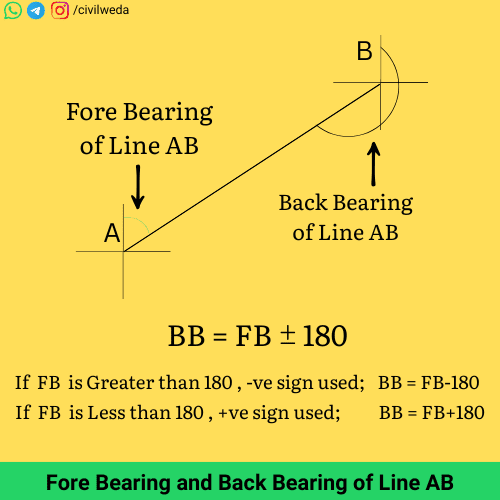
- Fore Bearing (FB): Bearing of a line measured in the direction of survey progress.
- Back Bearing (BB): Bearing of the same line measured in the opposite direction.
Relations:
In the WCB system:
BB = FB + 180° (if FB < 180°)
BB = FB – 180° (if FB > 180°)
In the QB system:
FB and BB have the same angle but lie in opposite quadrants.
For example: FB = N 40° E → BB = S 40° W
Magnetic Bearing
- The bearing is measured with respect to the magnetic north, as indicated by a compass needle.
- It varies slightly due to the Earth’s magnetic field (magnetic declination).
- Commonly used for routine fieldwork with instruments like the Prismatic Compass.
True Bearing
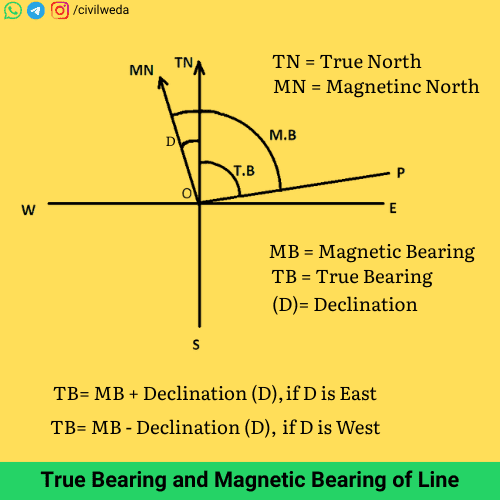
- The bearing is measured with respect to the geographical north or true north, which is constant at a given place.
- Used in precise surveys and mapping where high accuracy is required.
Formula for True Bearing - If the Magnetic Bearing (MB) of a line is known, the True Bearing (TB) can be calculated as:
True Bearing (TB) = Magnetic Bearing (MB) + Declination (D), (if D is East)
True Bearing (TB) = Magnetic Bearing (MB) – Declination (D), (if D is West)
Where: - TB = True Bearing
- MB = Magnetic Bearing measured by the compass
- D = Magnetic Declination (the angle between True North and Magnetic North)
Magnetic Declination in Surveying
- Magnetic Declination is the horizontal angle between the True North or (geographical north) and the Magnetic North shown by a compass needle.
- It is an important concept in surveying because most field instruments, like the Prismatic Compass, measure bearings with respect to the Magnetic North, while accurate maps and charts are usually prepared with respect to the True North. A typical diagram of Magnetic Declination is shown in the figure:
Differences Between Whole Circle Bearing (WCB) and Quadrantal Bearing (QB)
The types of bearing in surveying mainly include the Whole Circle Bearing (WCB) and the Quadrantal Bearing (QB) systems.
Both are used to measure the direction of survey lines, but they differ in their reference direction and the way angles are measured.
| Feature | Whole Circle Bearing (WCB) | Quadrantal Bearing (QB) / Reduced Bearing (RB) |
|---|---|---|
| Reference Direction | Measured clockwise from North | Measured from North or South towards East or West |
| Angle Range | 0° to 360° | 0° to 90° in each quadrant |
| Expression of Bearing | Written as a single angle (e.g. 120°) | Written with quadrant notation (e.g. N 40° E) |
| Common Instruments Used | Prismatic Compass, Theodolite | Surveyor’s Compass |
| Ease of Computation | Easier for plotting and calculations | Needs conversion to WCB for computation |
| Field Usage | Mostly used in modern surveying work | More common in traditional compass surveys |
Tips to Master Bearings in Surveying
Mastering the types of bearings in surveying requires a clear understanding of the basics and consistent practice.
The following tips will help students and beginners grasp the concept easily and avoid common mistakes during fieldwork and exams.
Understand the Reference Directions
The first step in learning the types of bearings in surveying is to clearly understand the reference directions.
Bearings are measured either from the North direction (as in WCB and True Bearing) or from the North/South towards East or West (as in Quadrantal Bearing). Visualising the four quadrants — NE, SE, SW, and NW — before taking readings helps reduce confusion and errors.
Practice Conversions Between WCB and QB
Many students struggle with converting bearings from one system to another. Regularly practising the conversion between Whole Circle Bearing (WCB) and Quadrantal Bearing (QB) makes it easier to solve numerical problems.
For example:
👉 WCB of 270° = QB of S 90° W
👉 QB of N 40° E = WCB of 40°
Practising these conversions daily strengthens problem-solving skills and improves exam performance.
Use Diagrams for Visualisation
Diagrams play an important role in understanding the types of bearings in surveying.
Drawing a compass rose with North, East, South, and West directions and then plotting the bearings visually helps in quickly remembering angle positions.
This method makes theoretical concepts easier to grasp and apply in fieldwork.
Learn the Relation Between Fore Bearing (FB) and Back Bearing (BB)
The relationship between Fore Bearing and Back Bearing is a fundamental part of bearings.
- In the WCB system:
👉BB = FB + 180° (if FB < 180°)
👉BB = FB – 180° (if FB > 180°) - In the QB system:
The angle remains the same, but lies in the opposite quadrant or simply direction
For example: FB = N 40° E → BB = S 40° W
Understanding and applying this relation during fieldwork helps in error checking and ensures accurate readings.
Use Quality Instruments and Avoid Errors
Accuracy in measuring bearings depends on the quality and proper use of instruments. Always use a well-calibrated Prismatic Compass or Theodolite for reliable results. Check for local attraction errors by comparing the FB and BB of a survey line. Minimising instrumental and observational errors leads to better field results.
Revise and Solve Numerical Problems
Regular revision is key to mastering the types of bearings in surveying. Students should solve previous years’ exam problems and practice questions related to conversions, FB & BB calculations, and error detection. Frequent practice boosts confidence and ensures better accuracy in both exams and real-world fieldwork.
Read more Civil Engg topics
- Per Capita Water Demand
- Pile foundation
- Drip Irrigation
- Instrument used in a chain survey
- Bulking of sand
- Bitumen concrete
- Viscosity
- Surface Tension
Conclusion
Understanding the types of bearings in surveying is one of the most essential skills for every civil engineering student and surveyor. Bearings provide the basic directional reference needed to locate points on the ground and prepare accurate maps. A strong grasp of these concepts not only helps in avoiding mistakes during fieldwork but also improves performance in academic exams and competitive tests.
The five major types of bearing in surveying — Whole Circle Bearing (WCB), Quadrantal Bearing (QB), Fore Bearing and Back Bearing, Magnetic Bearing, and True Bearing — each serve a specific purpose. Knowing when and how to use them allows surveyors to work with precision and efficiency in different field conditions.
Regular practice of conversions between WCB and QB, understanding the relationship between Fore Bearing and Back Bearing, and visualising directions using diagrams are some of the best ways to master this topic. Using accurate instruments and checking for errors, such as local attraction, also ensures reliable results in fieldwork.
In short, mastering the types of bearings in surveying builds a strong foundation for advanced surveying techniques. With clear concepts, consistent practice, and the right tools, students can perform better in exams and professionals can achieve greater accuracy in mapping and construction projects.
FAQs on Types of Bearings in Surveying
Below are some common questions and their answers that help students clear doubts about the types of bearings in surveying.
Q1. What are the main types of bearings in surveying?
The main types of bearings in surveying are:
Whole Circle Bearing (WCB)
Quadrantal Bearing (QB) / Reduced Bearing (RB)
Fore Bearing (FB) and Back Bearing (BB)
Magnetic Bearing
True Bearing
Q2. Which direction is used as a reference in WCB and QB?
In the Whole Circle Bearing (WCB) system, the bearing is measured clockwise from the North direction.
In the Quadrantal Bearing (QB) system, the bearing is measured from either the North or the South towards the East or West, whichever is nearer.
Q3. What is the difference between Magnetic Bearing and True Bearing?
Magnetic Bearing is measured with respect to the magnetic north indicated by a compass needle.
True Bearing is measured with respect to the geographical (true) north, which remains constant at a location.
For high-precision surveys and mapping, True Bearing is preferred.
Q4. How are Fore Bearing (FB) and Back Bearing (BB) related?
The relation between FB and BB depends on the system used:
In the WCB system:
BB = FB + 180° (if FB < 180°)
BB = FB – 180° (if FB > 180°)
In the QB system, the angle remains the same, but the direction (quadrant) is reversed.
Example: FB = N 40° E → BB = S 40° W
Q5. Why is it important to understand the types of bearings in surveying?
A clear understanding of the types of bearings in surveying helps in:
Reducing errors in field measurements
Preparing accurate maps
Solving exam questions quickly
Building strong fundamentals for advanced surveying techniques
Thank You for Reading! 🙏
We hope this article helped you clearly understand the types of bearings in surveying in civil engineering. If you found this complete article useful, please share it with your friends and university students. For more informative posts on civil engineering topics, stay connected with Civil Weda. 🚀

