
Introduction

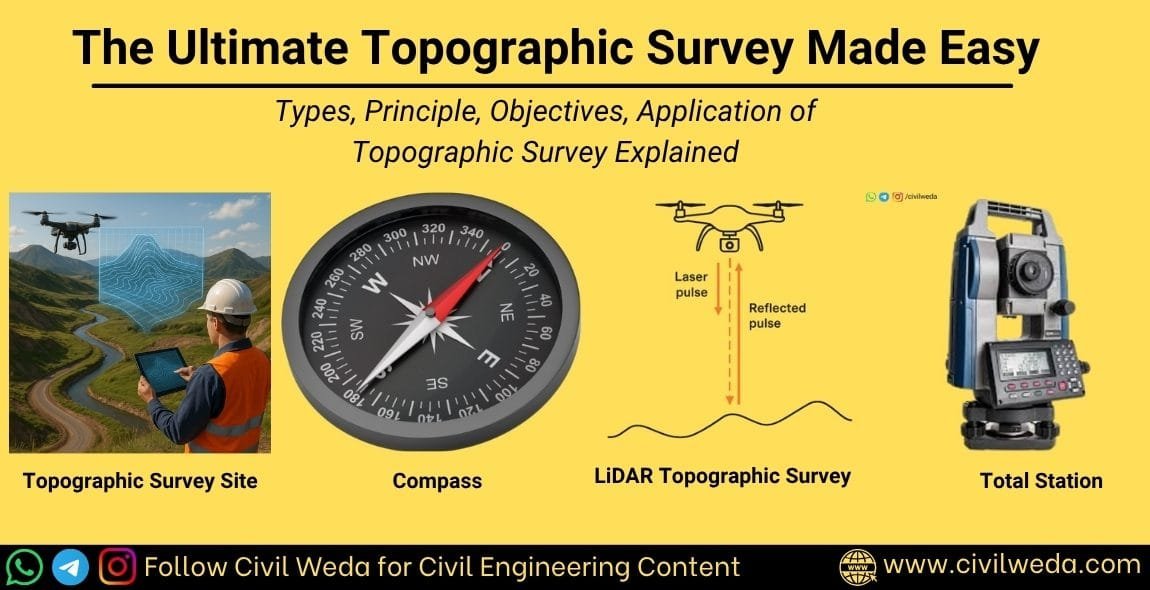
Topographic Survey is one of the most important branches of surveying in civil engineering. It deals with determining the positions and elevations of natural and man-made features on the earth’s surface, such as hills, rivers, valleys, roads, buildings, and bridges. The information collected through a topographic survey is represented on a topographic map, which shows not only the location of features but also the shape of the land by using contour lines.
In modern civil engineering projects, topographic surveys play a vital role in the planning, design, and execution of roads, railways, dams, canals, drainage systems, and urban development works. With the advancement of technology, traditional methods like chain and compass have been supported and sometimes replaced by modern tools such as GPS, drones, and LiDAR, which make surveys faster, more accurate, and more efficient.
👉 In this article, we will discuss the definition, objectives, types, procedure, instruments, LiDAR technique, and real-world applications of topographic survey in civil engineering.
A clear understanding of the topographic survey helps students, engineers, and professionals to select the right method, use appropriate instruments, and interpret the survey data effectively for real-world projects.
What is Topographic Survey?
A Topographic Survey is a type of land survey that determines the relative positions and elevations of natural and man-made features on the earth’s surface.
The primary purpose of this survey is to represent the shape of the land (terrain) along with the location of features such as hills, rivers, trees, buildings, roads, and bridges on a topographic map.
In civil engineering, a topographic survey provides essential data for the planning, design, and construction of infrastructure projects like roads, dams, canals, railways, and drainage systems.
The survey results are usually presented in the form of maps with contour lines, which show both the horizontal positions and the vertical elevations of ground features.
👉 In simple words:
A topographic survey shows “what is on the land and how the land’s surface looks”, helping engineers and planners to work accurately.
Principle of Topographic Survey
The principle of topographic survey is based on the measurement of horizontal and vertical positions of points on the earth’s surface in order to represent the natural and man-made features of an area on a map.
In this type of survey, the positions of features such as hills, rivers, lakes, roads, forests, and buildings are determined in plan (horizontal location) as well as in elevation (vertical height). By combining these two kinds of data, a topographic map can be prepared that shows not only the outline of the land but also its relief — that is, how high or low the ground is at different places.
Objectives of Topographic Survey
The main objective of a Topographic Survey is to collect accurate information about the natural features, man-made structures, and elevations of an area. This data is essential for engineers, planners, and architects to design and execute construction projects effectively.
The key objectives are explained below:
To Determine Natural Features
A topographic survey identifies and records the natural elements of the land, such as hills, valleys, rivers, lakes, ponds, forests, and other landforms. Understanding these features is important because they influence how and where civil engineering projects like roads, dams, and canals can be planned and executed.
To Locate Man-Made Features
The survey also determines the exact positions of built structures, including roads, railways, bridges, pipelines, drainage systems, buildings, and other utilities. Mapping these features helps engineers integrate new projects with the existing infrastructure and avoid potential conflicts during construction.
To Measure Elevations
Another important goal of a topographic survey is to measure the heights or depths of different points on the land surface. This information helps in understanding the shape and slope of the terrain and is usually represented on topographic maps by contour lines, which are essential for drainage design, earthwork calculations, and flood management.
To Prepare Topographic Maps
Topographic surveys provide data to create detailed maps that show both the horizontal positions and the vertical elevations of all significant natural and artificial features. These maps serve as the base for planning and designing infrastructure such as roads, canals, railways, and urban layouts.
For Planning and Design of Projects
Accurate survey data support the alignment of roads and railways, selection of sites for dams, canals, and reservoirs, and development of irrigation, drainage, and flood management systems. It is equally valuable for urban and rural development projects.
To Support Construction Activities
During the construction phase, topographic surveys assist engineers in choosing suitable sites, estimating the required cut-and-fill earthwork, and planning excavation and filling operations. This ensures cost-effective resource management and smooth project execution.
Types of Topographic Survey
Topographic surveys can be performed using different techniques depending on the size of the area, the nature of the terrain, and the required accuracy. Each method has its own advantages and is chosen according to project needs. The major types of topographic surveys are explained below.
1. Plane Table Survey
The plane table survey is one of the oldest and simplest methods of topographic surveying. In this method, observations and plotting are done simultaneously in the field using a drawing board mounted on a tripod. It is most suitable for small and relatively level areas where high accuracy is not required. Its main advantage is that the map is drawn directly on-site, which reduces the chances of mistakes during plotting.
2. Chain and Compass Survey
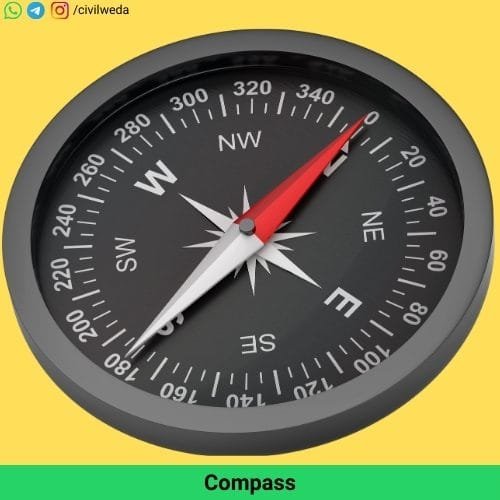
The chain and compass survey is a traditional method where distances are measured using a chain or tape, and directions are recorded using a magnetic compass. It is mostly used for small-scale surveys in open and less undulating areas. Although it is simple and inexpensive, it is less accurate than modern methods and not suitable for hilly or densely built regions.
3. Theodolite Survey
Theodolite surveys use a theodolite, an instrument that measures horizontal and vertical angles with high precision. This method is suitable for large-scale projects such as road and railway alignments, dam sites, and bridge locations where both accuracy and detail are required. Theodolite surveys provide better results than chain or compass surveys.
4. Levelling-Based Survey
Levelling-based surveys focus primarily on determining the elevations of points on the ground. This data is crucial for preparing contour maps and for projects such as canals, drainage systems, irrigation works, and construction site development. Levelling instruments like the Dumpy Level or Auto Level are used to ensure precise vertical measurements.
5. Tacheometric Survey
Tacheometric surveys are carried out using a tacheometer, which allows surveyors to measure both horizontal distances and elevations indirectly. This method is especially useful in hilly and rough terrains where using a chain or tape is difficult and time-consuming. Tacheometric surveys are often employed for preliminary route surveys for roads, railways, and pipelines.
6. Aerial Survey
Aerial surveys involve capturing photographs of the ground surface from aircraft or drones. The photographs are then used to prepare maps and models of the terrain. This method is particularly effective for large areas, floodplains, forested regions, and inaccessible terrains, where ground surveys would be slow or impractical.
7. Photogrammetric Survey
Photogrammetric surveys use overlapping photographs taken from aircraft or drones.
Specialized software processes these images to generate 3D terrain models and accurate topographic maps.
It is a preferred method for mapping mountainous regions, river valleys, and disaster-prone areas due to its speed and coverage.
8. GPS or GNSS Survey
The GPS (Global Positioning System) or GNSS (Global Navigation Satellite System) survey uses satellite-based technology to determine the precise coordinates of ground points. It is widely used for extensive surveys because it is fast, accurate, and efficient, and can be combined with GIS (Geographic Information Systems) for advanced mapping.
9. LiDAR Topographic Survey (Modern Technique)
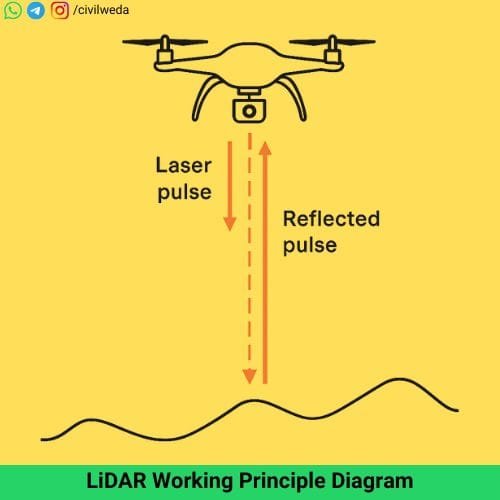
LiDAR (Light Detection and Ranging) is an advanced remote sensing technology that uses laser pulses to measure the distance between the sensor and the ground. Mounted on drones, aircraft, or vehicles, LiDAR can collect highly accurate 3D elevation data even in areas covered by vegetation. It is particularly useful for floodplain mapping, hilly terrain studies, urban development, forestry, and disaster management.
LiDAR surveys are faster and more precise than many traditional methods, though they require specialized equipment and higher costs.
Procedure of Topographic Survey
The procedure of a Topographic Survey is a systematic process designed to collect accurate field data and represent it on a map for engineering purposes.
Following a proper sequence ensures reliability and efficiency.
The standard procedure of a Topographic Survey is described below.
1. Reconnaissance Survey
The first step is a preliminary field inspection of the area to be surveyed. Surveyors visit the site to study the terrain, identify obstacles, select suitable stations, and decide the methods and instruments to be used. This step provides a clear understanding of the field conditions and helps in planning the rest of the survey effectively.
2. Establishing Control Points
In this step, horizontal and vertical control points are established to serve as references for all subsequent measurements. Horizontal control points fix the positions of locations on the ground, while vertical control points (or benchmarks) provide elevation data. Modern instruments like theodolites, Total Station, or GPS are used to set up these reference points accurately.
3. Field Data Collection
After establishing control points, surveyors begin collecting detailed measurements of the land. This includes recording distances, angles, elevations, and positions of both natural and man-made features such as rivers, hills, roads, buildings, and drainage systems. Advanced tools like Total Stations, GPS, drones, and LiDAR help to speed up data collection and improve accuracy.
4. Levelling and Contouring
This step focuses on determining the elevations of points on the ground. Levelling instruments such as Dumpy Levels or Auto Levels are commonly used for this purpose. The data collected is then used to draw contour lines on a map, which represent the shape, slope, and elevation of the terrain. Contours are especially important in projects like road and canal alignments, drainage planning, and flood management.
5. Plotting the Data
Once the field data is collected, it is transferred onto a drawing sheet or into digital mapping software. Surveyors plot the positions and elevations of all recorded features to prepare a topographic map, which is drawn to a chosen scale. Modern computer-based tools such as AutoCAD and GIS software make plotting more accurate and faster.
6. Verification and Adjustment
The plotted data is carefully checked for errors or inconsistencies by comparing it with field notes and existing maps. Any discrepancies found are corrected, and necessary adjustments are made to ensure the final map is accurate and reliable.
7. Preparation of Final Topographic Map
The last step is to prepare a clean, final topographic map that includes all necessary details such as contour lines, elevations, symbols, scales, and a north direction. This map serves as the official reference for engineers, planners, and decision-makers in the design and execution of civil engineering projects.
Instruments Used in Topographic Survey
The success of a Topographic Survey largely depends on the use of proper instruments. Different types of instruments are selected based on the survey method, size of the area, terrain conditions, and the required accuracy.
The major instruments used in topographic surveying are described below.
1. Plane Table
The plane table is a simple instrument that consists of a drawing board mounted on a tripod.
It is mainly used for field plotting, where observations and map drawing are carried out simultaneously on the site.
This instrument is ideal for small-scale surveys in relatively flat areas.
2. Chain or Tape
Chains and measuring tapes are the most basic instruments used to measure horizontal distances between points on the ground.
Although modern equipment has replaced them in most large-scale surveys, they are still used in short-distance measurements or as auxiliary tools.
👉 For a detailed explanation of tools used in chain-based fieldwork, read our guide on Instruments Used in Chain Surveying
3. Compass
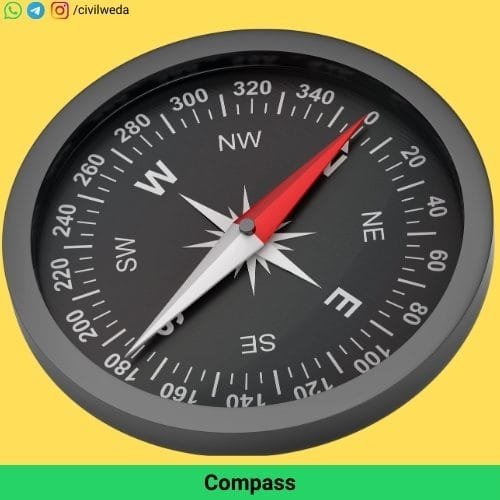
The compass is used to measure directions or bearings of survey lines relative to the magnetic north.
It is lightweight and easy to use, making it suitable for preliminary surveys or for areas where a quick measurement of directions is required. However, its accuracy can be affected by magnetic interference from nearby metallic objects.
👉 To learn more about the basic field method, check our detailed post on Compass Survey
4. Theodolite
The theodolite is a precision instrument used to measure horizontal and vertical angles.
It is an essential tool for large-scale topographic surveys, especially for road and railway alignments, dam sites, and other infrastructure projects that demand high accuracy.
5. Tacheometer
A tacheometer is a special type of theodolite equipped to measure horizontal distances and elevations indirectly.
It is particularly useful in hilly or difficult terrains, where using a chain or tape is time-consuming.
Tacheometric surveys are widely used for preliminary route surveys of roads, railways, and pipelines.
6. Levelling Instruments
Levelling instruments, such as the Dumpy Level, Auto Level, and Digital Level, are used to determine the elevations of points on the ground.
They are essential for preparing contour maps and for engineering projects like canals, drainage systems, and construction site development, where precise elevation data is crucial.
7. Total Station
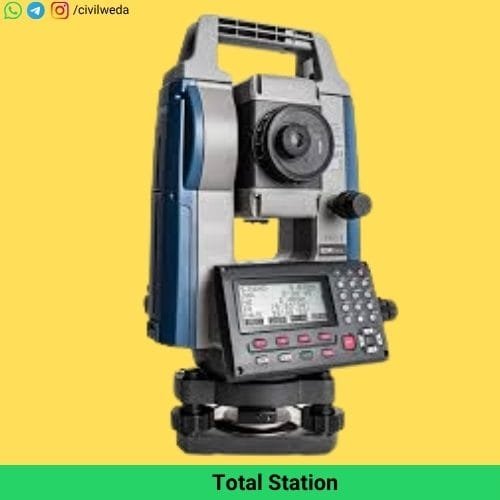
A total station is a modern electronic instrument that combines the functions of a theodolite, electronic distance measurement (EDM), and data recording in one device. It provides highly accurate measurements of distances, angles, and elevations, making it ideal for both small and large-scale topographic surveys.
8. GPS/GNSS Equipment
GPS (Global Positioning System) and GNSS (Global Navigation Satellite System) receivers are used to determine the precise coordinates of points on the Earth’s surface.
They are fast, efficient, and extremely useful for large-scale surveys and integration with GIS-based mapping systems.
9. Drones (UAVs)
Drones or Unmanned Aerial Vehicles (UAVs) are increasingly being used in modern topographic surveys to capture high-resolution aerial images and videos. When combined with photogrammetric techniques, drones can produce detailed 3D terrain models over large and inaccessible areas.
10. LiDAR (Light Detection and Ranging) Equipment
LiDAR is an advanced remote sensing technology that uses laser pulses to measure the distance between the sensor and the ground.
Mounted on drones, aircraft, or vehicles, it can quickly capture highly accurate 3D elevation data, even under vegetation cover.
LiDAR is particularly valuable for floodplain mapping, hilly terrain studies, forestry, and disaster management projects.
LiDAR is widely used for floodplain mapping and terrain modeling, as explained by the USGS 3D Elevation Program
Contours in Topographic Survey
Contours are an essential part of a topographic survey as they represent the shape and elevation of the land surface on a map. A contour is an imaginary line on the ground that connects all points having the same elevation. By studying the pattern of these lines, engineers can understand the slope, relief, and form of the terrain without visiting the site.
Contours are extremely useful in civil engineering because they provide information about the natural ground profile, which is required for the planning and design of roads, railways, canals, drainage systems, and other infrastructure projects. They also help in calculating earthwork quantities for cutting and filling in construction projects.
Topographic Map
A topographic map is the main output of a topographic survey. It is a detailed representation of the Earth’s surface that shows both natural and man-made features along with their elevations. Such maps are created using field data collected through various survey methods and instruments. They allow engineers, planners, and architects to visualize the terrain and make informed decisions for planning and construction.
Topographic maps are widely used in civil engineering projects such as road and railway alignment, site selection for dams and canals, and urban development. By studying these maps, professionals can understand the ground profile, slope, and elevation differences without physically visiting the site.
For official mapping standards and geospatial guidelines in India, visit the Survey of India Geospatial Guidelines
Applications of Topographic Survey
Topographic surveys are essential in civil engineering and related fields because they provide accurate data about the terrain and surface features of an area. This information helps engineers and planners design and execute infrastructure projects with precision. The main applications of topographic surveys are explained below.
Road and Railway Alignment
Topographic surveys are crucial for determining the most suitable routes for roads and railways. By analyzing the terrain through contour maps and elevation data, engineers can identify the most economical and practical alignment. This reduces construction costs by minimizing the amount of cutting and filling required, and it ensures safe and efficient routes.
Site Selection for Dams and Reservoirs
The construction of dams and reservoirs requires careful study of the terrain to ensure safety and stability. Topographic surveys provide detailed information about the slopes, elevations, and surrounding land features. This helps engineers select the most suitable sites and design structures that can store water efficiently and withstand environmental conditions.
Canal, Drainage, and Irrigation Planning
Topographic surveys are widely used in the planning and design of canals, drainage systems, and irrigation networks. By studying the natural slopes and elevations, engineers can design channels that allow water to flow efficiently with minimal pumping. Proper alignment based on topographic data reduces construction costs and improves water management.
Urban and Rural Development
In both urban and rural development, topographic surveys provide essential data for land-use planning, zoning, road networks, and public utilities. They help in identifying suitable areas for residential, industrial, and commercial projects. The surveys also ensure that the planned development aligns well with the natural terrain, reducing the risk of environmental and structural issues.
Floodplain Mapping and Disaster Management
Topographic surveys are important for identifying flood-prone areas by providing detailed information about ground elevations and slopes. This data is used to create floodplain maps, which help in designing flood control measures such as levees and drainage channels. They also assist in disaster management and risk assessment by enabling authorities to prepare for and respond to natural hazards like floods and landslides.
Construction Projects and Earthwork Estimation
During the planning and construction of infrastructure projects, topographic surveys help in estimating the volume of earthwork required for excavation, cutting, and filling. Accurate data on ground elevations ensures better project budgeting and reduces wastage of resources. This application is critical for roads, bridges, buildings, and other large-scale projects.
Advantages and Limitations of Topographic Survey
Topographic surveys are widely used in civil engineering projects because they provide essential information about the terrain and surface features of an area. Like any other surveying technique, they have both advantages and limitations, which are important to understand for selecting the right method and tools.
Advantages of Topographic Survey
- One of the major advantages of a topographic survey is that it provides detailed and accurate information about the natural and artificial features of the land. This data is essential for engineers and planners to design infrastructure projects such as roads, railways, canals, dams, and urban developments with confidence.
- Topographic surveys also provide precise elevation data through contour mapping, which helps in understanding the slope and shape of the land. This is particularly useful for calculating earthwork quantities for cutting and filling, as well as for designing efficient drainage and irrigation systems.
- Modern instruments like total stations, GPS, drones, and LiDAR have significantly improved the speed and accuracy of topographic surveys. These technologies reduce fieldwork time, allow data to be processed digitally, and enable engineers to work on large or inaccessible areas more efficiently.
- Another key advantage is that topographic maps serve as reliable reference documents during the construction phase. They help contractors and project managers make informed decisions and reduce errors, saving both time and resources.
Limitations of Topographic Survey
- Despite its advantages, topographic surveying has some limitations. Traditional methods such as plane table, chain, and compass surveys can be time-consuming and require a lot of manual effort. These methods may also be less accurate in areas with rough or densely vegetated terrain.
- The accuracy of measurements can be affected by weather conditions, such as heavy rain, fog, or strong winds, which can limit visibility and make it difficult to take precise readings. In addition, the use of certain instruments, like the compass, can be influenced by magnetic disturbances in the field.
- Modern techniques such as LiDAR and drone surveys, while highly accurate and efficient, can be expensive due to the cost of equipment and software. They also require trained personnel to operate and interpret the data, which may not be feasible for small-scale projects.
Read more Civil Engg topics
- Compass survey
- Per Capita Water Demand
- Pile foundation
- Drip Irrigation
- Instrument used in a chain survey
- Fillet Weld
- Bulking of sand
- Bitumen concrete
Conclusion
A topographic survey is an essential part of civil engineering because it provides detailed information about the terrain and the positions of natural and man-made features. This data helps engineers and planners design safe, cost-effective, and efficient infrastructure projects.
With the use of modern tools such as total stations, GPS, drones, and LiDAR, topographic surveys have become faster and more accurate. As technology continues to advance, these surveys will play an even greater role in improving the planning, design, and execution of future construction and development projects.
FAQs on Topographic Survey in Civil Engineering
What is a Topographic Survey?
A topographic survey records the positions and elevations of natural and man-made features on the land, shown on maps using contour lines.
What are the main types of Topographic Survey?
The main types include plane table, chain and compass, theodolite, levelling, tacheometric, aerial, photogrammetric, GPS, and LiDAR surveys.
What is the difference between a Topographic Survey and a Cadastral Survey?
A topographic survey maps terrain and features for engineering, while a cadastral survey defines land boundaries for legal and ownership purposes.
Which instrument is commonly used in Topographic Surveys?
Common instruments include theodolites, total stations, GPS, drones, and LiDAR for modern, faster, and more accurate surveys.
What is the scale of a Topographic Map?
Large-scale maps like 1:1,000 show more details for small areas, while small-scale maps like 1:50000 cover larger regions.
Why is a Topographic Survey important for construction projects?
It provides terrain data needed for site selection, earthwork calculation, drainage design, and overall project planning.
What are the advantages of using LiDAR in Topographic Surveys?
LiDAR offers fast, highly accurate 3D elevation data, even in vegetated areas, making it ideal for large-scale and remote projects.
Thank You for Reading! 🙏
We hope this article helped you clearly understand the topographic survey in civil engineering. If you found this complete article useful, please share it with your friends and university students. For more informative posts on civil engineering topics, stay connected with Civil Weda. 🚀

