Introduction

Concrete is the backbone of modern construction. It is used in everything from small houses to mega-structures like Atal Setu, Mahatma Gandhi Setu, and the Statue of Unity, etc. Concrete provides strength, durability, and stability to every structure.
Generally, concrete is classified into two types, which are given by:
- Plain Cement Concrete (PCC)
- Reinforced Cement Concrete (RCC)
In this article, we will focus only on Plain Cement Concrete (PCC), which is the simplest form of concrete that has been in use for more than two centuries.
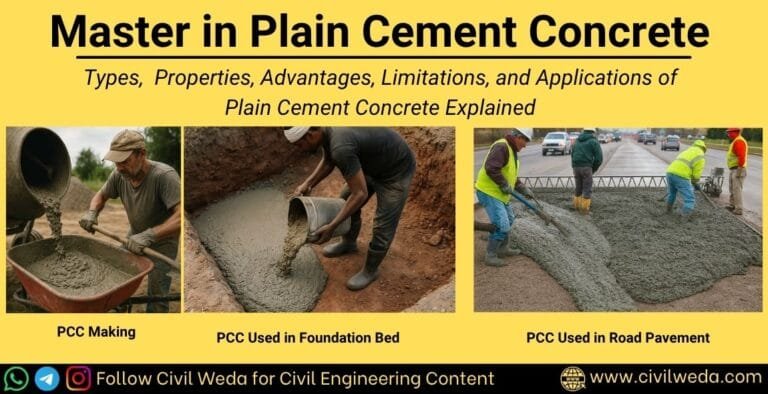
Today, Plain Cement Concrete (PCC) is widely used as a building material in foundations, floors, and road pavement construction. It is economical as compared to RCC, easy to prepare, and provides excellent compressive strength. However, it is not suitable for resisting tensile loads, so it is mostly used in places where the structure is subjected to compressive loads.
In this article, we will discuss the definition, composition, properties, advantages, disadvantages, and applications of Plain Cement Concrete (PCC) in civil engineering.
History of Plain Cement Concrete (PCC)
The idea of using a binding material to join stones is very old. The Romans, about two thousand years ago, built strong structures like aqueducts and the Pantheon using a mixture of lime, volcanic ash, and water.
Modern Plain Cement Concrete (PCC) came into use after Joseph Aspdin invented Portland cement in 1824 in England. By the middle of the 19th century, builders started mixing cement, sand, gravel, and water to make PCC for foundations, floors, and road works. Even today, PCC is widely used because it is simple, economical, and dependable for basic compressive load-bearing construction.
This short history shows how Plain Cement Concrete evolved from ancient Roman concrete to the modern material we still rely on today.
What is Plain Cement Concrete (PCC)?

Plain Cement Concrete (PCC) is the simplest form of concrete used in construction. It is made by mixing cement, sand, coarse aggregates (like gravel or crushed stones), and water in the right proportion.
When freshly prepared, Plain Cement Concrete is in a plastic state, which means it can be poured or placed into almost any shape or size. After it sets and hardens, it forms a solid mass that can safely bear heavy compressive loads.
Unlike Reinforced Cement Concrete (RCC), Plain Cement Concrete does not contain steel reinforcement. That is why it has good compressive strength but very low tensile strength, only about 10–15% of its compressive strength. For this reason, Plain Cement Concrete is used in locations where the concrete is mostly subjected to compressive loads, such as in foundations, floors, levelling courses, road pavement, and mass concreting works.
PCC has been in use for more than two centuries because:
- It is economical
- The raw materials are easily available
- It can be prepared and used on-site without sophisticated tools
- It is durable when properly mixed and cured
In modern civil engineering, PCC is commonly used as a base layer for foundations, flooring material, and for levelling uneven ground before placing RCC or masonry structures.
Composition and Mix Ratio of Plain Cement Concrete
The strength and durability of Plain Cement Concrete (PCC) largely depend on the quality of its ingredients and the correct proportion in which they are mixed. A well-designed mix ensures better performance and long-lasting results.
1. Ingredients of Plain Cement Concrete
Plain Cement Concrete is made using the following basic materials:
- Cement:
Ordinary Portland Cement (OPC) of Grade 33, 43, or 53 is usually used.
It acts as a binder, holding the sand and aggregates together after setting and hardening. - Fine Aggregates (Sand):
Clean, well-graded river sand or manufactured sand (M-sand) is preferred. It fills the gaps between coarse aggregates and helps in making the mix dense and workable. - Coarse Aggregates:
Crushed stone or gravel, typically of 20 mm nominal size, is used. These aggregates provide bulk and the main compressive strength to the hardened concrete. - Water:
Clean and potable water (free from harmful salts or organic matter) is used. It helps in the hydration of cement and makes the concrete mix workable.
2. Common Mix Ratios of Plain Cement Concrete
PCC is generally prepared in volumetric proportions (cement: sand: coarse aggregate). The choice of mix ratio depends on the type of work and the required strength.
| Mix Ratio (Cement: Sand: Coarse Aggregate) | Typical Use | Approx. Compressive Strength (28 days) |
| 1: 2: 4 | Used for higher strength works such as floors and pavements | ≈ 15–20 MPa |
| 1 : 3: 6 | Commonly used for foundation beds and flooring | ≈ 10–15 MPa |
| 1: 4: 8 | Used for mass filling or levelling a course. | ≈ 7–10 MPa |
These mix ratios are indicative. The exact proportion may vary depending on the type of cement, aggregate quality, and site requirements.
3. Water–Cement (w/c) Ratio
The water–cement ratio is one of the most critical factors in PCC as well as RCC. It is usually taken between 0.45 and 0.60
- Too much water makes the mix weak and porous, so it reduces its strength and durability of the concrete.
- Too little water makes the mix stiff and hard to place or compact properly. i.e., reduces its workability of concrete.
- Maintaining the right water–cement ratio is essential for achieving good strength and long-term performance of the concrete.
4. Quality Considerations
For best results:
- The materials should follow the guidelines given in IS 456:2000.
- Mix the ingredients well so that they are even throughout.
- Compact the concrete properly to remove air gaps and make it dense.
- Adequate curing (usually for at least 7–14 days) is necessary for strength development.
Properties of Plain Cement Concrete (PCC)
The performance of PCC in any structure depends on its key properties. Knowing these properties helps engineers decide where and how PCC should be used in construction.
1. Compressive Strength
Plain Cement Concrete (PCC) is mainly designed to resist compressive loads. Its strength varies with the mix ratio, quality of materials, and curing process. Generally, PCC achieves about 7–20 MPa of compressive strength after 28 days of proper curing. This makes it suitable for foundations, floors, road pavement, and mass concrete works.
2. Tensile Strength
Plain Cement Concrete is weak in resisting tensile stresses. Its tensile strength is only about 10–15% of its compressive strength. For example, if PCC has 20 MPa compressive strength, its tensile strength is only 2-3 MPa.
This is why Plain Cement Concrete is not used in structural members like beams, slabs, or columns where bending or tension is present. For such works, RCC (Reinforced Cement Concrete) is preferred.
3. Durability
If good-quality materials are used and proper curing is done, Plain Cement Concrete can last for decades. It can resist ordinary weather conditions like rain, sun, and mild exposure to moisture or frost. However, in aggressive environments (like chemical exposure), special care and mix design are required.
4. Workability
Freshly prepared Concrete is plastic and workable, which means it can be easily poured, spread, and compacted. Workability depends on:
- The water–cement ratio
- The size and grading of aggregates.
A proper balance is needed – too much water weakens the concrete, while too little water makes it hard to place and compact.
5. Volume Stability
Well-mixed and properly cured Plain Cement Concrete remains stable in volume. If curing is neglected or if excess water is used in the mix, it can lead to shrinkage cracks during drying.
6. Density
The density of Plain Cement Concrete is usually taken as 2400 kg/m³. It depends on the type and grading of aggregates used. Proper compaction increases density, which improves both the strength and durability of structures.
Advantages of Plain Cement Concrete (PCC)
As we know that PCC remains one of the most trusted building materials in the construction industry. Its benefits make it a popular choice for foundations, levelling courses, floors, and road pavement construction, where mainly compressive loads act. Here are some of the advantages of PCC discussed below.
1. Cost-Effective
Plain Cement Concrete is economical because it is made from easily available materials: cement, sand, gravel, and water. It does not require steel reinforcement, which reduces the overall construction cost.
2. Good Compressive Strength
Plain Cement Concrete can safely bear heavy compressive loads. This makes it ideal for foundations, plinth levels, floors, and road pavement, where the main force is compression rather than tension.
3. Durable and Long-Lasting
With good-quality materials and proper curing for at least 7–14 days, PCC gains enough strength to last for decades. It performs well under normal weather conditions, such as rain, sun, and moderate temperature changes.
4. Easy to Prepare and Use
Plain Cement Concrete can be mixed by hand for small works or by a mixer machine for large-scale projects. It does not need complex tools or highly skilled labour, which makes it practical for use even in remote sites.
5. Can Be Moulded into Any Shape
When freshly mixed, Plain Cement Concrete is in a plastic state and can be poured into formwork of different shapes and sizes. This makes it versatile for flooring, foundation beds, levelling courses, and base concrete for RCC works.
6. Low Maintenance
Once hardened and properly cured, PCC requires very little maintenance. It remains strong and stable for a long time without frequent repairs.
Disadvantages of Plain Cement Concrete (PCC)
Although PCC is strong and economical, it has certain limitations that restrict its use in modern construction. Understanding these drawbacks helps in selecting the right material for each structural element.
1. Low Tensile Strength
PCC is weak in tension. Its tensile strength is only about 10–15% of its compressive strength, which makes it unsuitable for beams, slabs, and columns that are subjected to bending or tensile forces.
For such works, Reinforced Cement Concrete (RCC) is preferred.
2. Brittle in Nature
PCC is brittle, which means it fails suddenly when it is overloaded, without showing a warning. This can be a concern in structures that face heavy loads or dynamic forces.
3. Prone to Shrinkage Cracks
If too much water is used in the mix or if curing is not done properly, PCC can develop shrinkage cracks as it dries. These cracks reduce the durability of the concrete.
4. Heavy Weight
PCC is relatively heavy compared to modern lightweight materials like Glass Fiber Reinforced Concrete (GFRC), which increases the dead load on the structure. This can be a disadvantage in high-rise buildings where weight reduction is very important.
5. Limited Use in Dynamic Loads
PCC is not suitable for structures that are exposed to vibrations, impact loads, or alternating stresses, such as bridges, highways, or machine foundations.
In such cases, RCC or specialized concrete is required.
6. Not Suitable for Aggressive Environments
In areas exposed to chemical attacks, saltwater, or extreme weather conditions, ordinary PCC may deteriorate over time unless special precautions (like using additives or protective coatings) are taken.
Applications of Plain Cement Concrete (PCC)
PCC is widely used in construction because of its good compressive strength, durability, and low cost. It is mainly applied in works where tensile stresses are negligible and the structure needs a strong, stable base.
Here are the most common applications of PCC:
1. Foundation Beds
PCC is commonly used as a base layer below RCC footings and masonry walls. It provides a strong, level, and stable surface for the foundation and prevents direct contact between the soil and structural concrete.
2. Flooring
PCC is used for ground floors in residential, commercial, and industrial buildings. It offers a smooth, hard-wearing surface and acts as a base for finishing layers such as tiles, marble, or concrete screed.
3. Road Base and Pavements
In road construction, PCC is often used as a base or sub-base layer beneath asphalt or rigid concrete pavements. It distributes the load evenly and helps in maintaining road durability.
4. Levelling Course
PCC is used as a levelling layer on uneven ground before placing RCC structures, machinery foundations, or flooring. It ensures a uniform, stable surface for further construction work.
5. Mass Concreting Works
PCC is suitable for large-volume concreting where the main requirement is compressive strength. It is often used in dams, retaining walls, and thick concrete rafts.
6. Pedestals for Columns and Machinery
PCC is commonly placed as a bed for columns, piers, and heavy machinery. Its high compressive strength provides a stable support for transferring loads to the foundation.
7. Drainage and Canal Lining
In some infrastructure projects, PCC is used for lining drains, canals, and open channels to prevent erosion and provide a durable surface.
Read more Building Materials Topics
Conclusion
Plain Cement Concrete (PCC) is one of the oldest and most reliable construction materials. It is strong in compression, economical, and easy to prepare, which makes it highly suitable for foundation beds, road bases, flooring, and mass concreting works.
However, PCC has very low tensile strength and is brittle in nature, which is why it is not used for structural members such as beams, slabs, or columns. For those applications, Reinforced Cement Concrete (RCC) is preferred.
In short:
👉 PCC is the right choice for compressive load-bearing works where durability, stability, and cost-effectiveness are important.
👉 For tension-bearing elements, PCC is replaced by RCC or other advanced materials.
With the right mix, good materials, proper compaction, and good curing, PCC forms a strong and long-lasting base.
FAQs on Plain Cement Concrete
1. What is the typical mix ratio for Plain Cement Concrete in foundations?
Commonly used mix ratios for foundation PCC are 1:3:6 or 1:4:8, depending on design requirements and soil conditions.
2. Why is Plain Cement Concrete used below RCC footings?
Plain Cement Concrete acts as a strong and level base for RCC footings. It prevents the foundation from coming in direct contact with soil and distributes the load evenly.
3. What is the compressive strength of Plain Cement Concrete?
1. What is the typical mix ratio for Plain Cement Concrete in foundations?
Commonly used mix ratios for foundation PCC are 1:3:6 or 1:4:8, depending on design requirements and soil conditions.
2. Why is Plain Cement Concrete used below RCC footings?
Plain Cement Concrete acts as a strong and level base for RCC footings. It prevents the foundation from coming in direct contact with soil and distributes the load evenly.
4. Is Plain Cement Concrete suitable for structural members?
No. Plain Cement Concrete is not suitable for structural components like beams, slabs, or columns because it has low tensile strength. For such elements, RCC is used.
5. Which IS code provides guidelines for Plain Cement Concrete?
IS 456:2000 provides specifications and guidelines for both Plain Cement Concrete and Reinforced Cement Concrete.
6. How long should Plain Cement Concrete be cured for good strength?
PCC should be kept moist for at least 7 days, and ideally 14 days, to ensure proper hydration of cement and achieve good strength.
Thank You for Reading! 🙏
We hope this article helped you clearly understand the Plain Cement Concrete (PCC) in civil engineering. If you found this complete article useful, please share it with your friends and university students. For more informative posts on civil engineering topics, stay connected with Civil Weda. 🚀