
Introduction
In hydraulic engineering, understanding how water flows in an open channel is extremely important. Whether it is a river, canal, spillway, or drainage system, the behaviour of flowing water changes with its depth, velocity, and the effect of gravity. To describe this behaviour in a practical and scientific manner, engineers use a very important dimensionless parameter known as the Froude Number.
The Froude Number helps identify whether the flow is calm, critical, or extremely rapid. It acts as an indicator that shows how strongly gravity controls the motion of water compared to its velocity. Because of its wide applications in canal design, spillway analysis, river training, and flood studies, this parameter holds great importance for both students and practising engineers.
In this article, we will understand the concept of the Froude Number in a simple and clear way so that you can easily connect it with real engineering problems. So let’s get started…
What is Froude Number?
The Froude Number (Fr) is a dimensionless parameter that compares the inertial force of flowing water to the gravitational force acting on it. In simple words, it tells us how fast water is moving in relation to the effect of gravity. In simple words, we can say that the Froud Number is the ratio of the inertia force to the gravity force.
Engineers use this number to understand whether the flow in an open channel is calm, critical, or very fast. Because gravity plays a major role in open-channel flow, the Froude Number becomes a key factor in analysing canals, rivers, spillways, and hydraulic structures.
I have also explained the Reynolds Number in detail. If you’re interested, you can click here to read it… Reynolds Number
Formula of Froude Number
The Froude Number is given by the formula:
Where:
- V = Velocity of flow (m/s)
- g = Acceleration due to gravity (9.81 m/s²)
- L = Characteristic length (usually hydraulic depth)
- Fr= Froude Number
This formula shows that the Froude Number increases when water velocity increases and decreases when the effect of gravity becomes more dominant.
Physical Meaning of Froude Number
The Froude Number tells us how water will behave in an open channel by comparing its speed with the effect of gravity. It shows whether the flow is dominated by velocity or controlled by gravity.
A simple way to understand this is:
- If gravity controls the flow, water moves smoothly and calmly.
- If velocity dominates, water becomes fast, shallow, and aggressive.
In practical terms, the Froude Number indicates whether waves can move upstream or not:
- When the flow is slow, waves can travel in both directions.
- When the flow becomes very fast, waves cannot move upstream and are quickly washed away.
This makes the Froude Number a very useful tool for engineers while studying river behaviour, designing spillways, analysing hydraulic jumps, and predicting water surface profiles.
Types of Flow Based on Froude Number
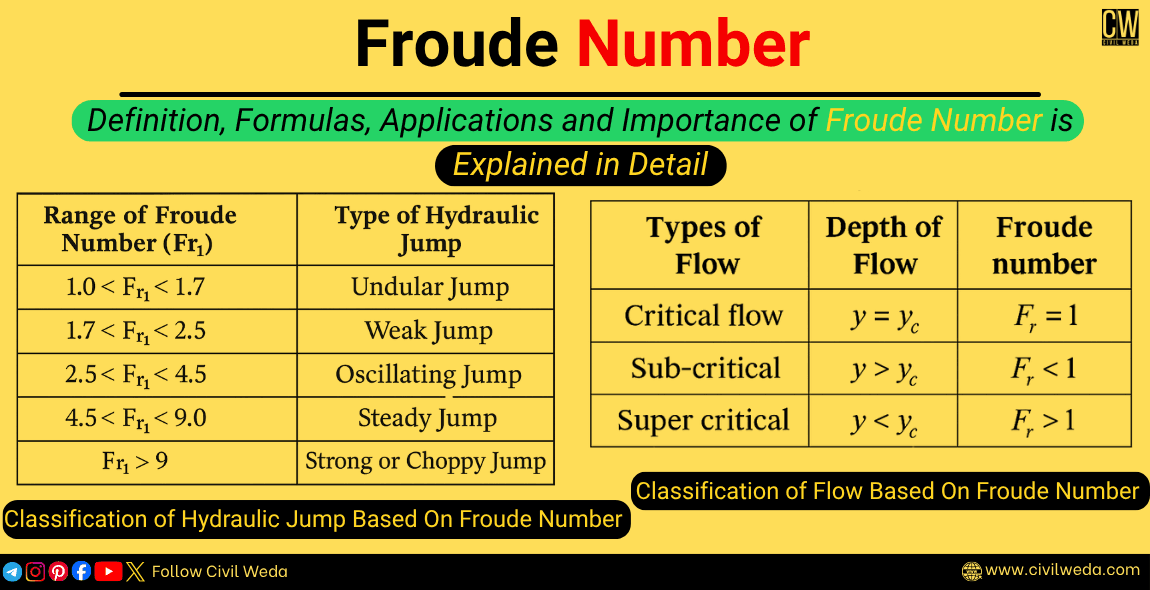
The behaviour of water in an open channel changes according to the value of the Froude Number. Based on this value, the flow is classified into three main types: subcritical, critical, and supercritical flow. Each type has its own characteristics and engineering importance.

a. Subcritical Flow (Fr < 1)
In subcritical flow, gravity is stronger than the velocity of water.
- Flow is slow, deep, and stable.
- Waves can move upstream and downstream easily.
- Suitable for canals and irrigation channels where smooth flow is required.
This type of flow is also known as tranquil flow.
b. Critical Flow (Fr = 1)
This is a special condition where the effect of gravity and velocity becomes equal.
- Water flows with minimum specific energy.
- Even a small change in depth or velocity can disturb the flow.
- Found near control sections like weirs, spillway crests, and canal transitions.
Critical flow acts like a dividing line between slow and fast flow.
c. Supercritical Flow (Fr > 1)
In supercritical flow, the velocity of water is stronger than the effect of gravity.
- The flow becomes very fast, shallow, and sometimes violent.
- Waves cannot travel upstream; they only move downstream.
- Common in steep channels, spillways, and flood discharges.
This type of flow is also called rapid flow.
Importance of Froude Number in Civil Engineering
The Froude Number is one of the most useful parameters in open-channel hydraulics. It helps engineers understand how water behaves in canals, rivers, spillways, and drainage systems. Many important design decisions depend on whether the flow is subcritical, critical, or supercritical.
Below are the key reasons why the Froude Number is extremely important in civil engineering:
a. Canal Design and Stability
While designing a canal, engineers must ensure that the flow stays smooth and stable.
- Subcritical flow (Fr < 1) is preferred because it reduces erosion, scouring, and turbulence.
- If the flow becomes supercritical, it can damage the canal lining and increase energy losses.
Thus, allowed velocity and depth are often checked using the Froude Number.
b. Hydraulic Jump Analysis
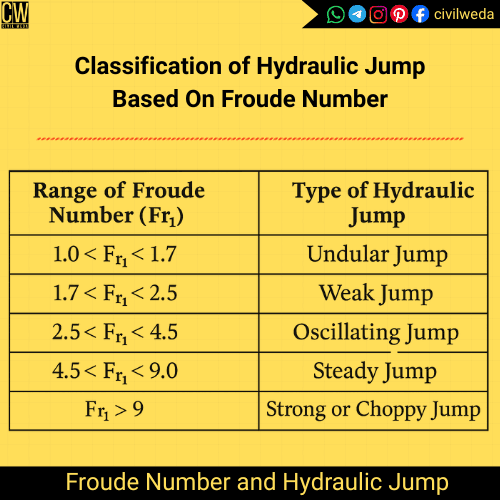
A hydraulic jump is a sudden rise in water depth when fast-moving water changes to slow flow.
- This phenomenon is directly analysed using the Froude Number.
- A higher Froude Number means a stronger hydraulic jump, which is used for energy dissipation.
Design of stilling basins downstream of spillways depends on this value.
c. Spillways and Dams
Water flowing over a spillway often becomes supercritical.
- Engineers use the Froude Number to determine how the flow will behave after leaving the spillway.
- It helps in designing the bucket, stilling basin, and downstream protection to avoid erosion and structural damage.
d. River Engineering and Flood Analysis
During floods, river flow becomes rapid and unpredictable.
- The Froude Number helps identify where the flow might turn into supercritical.
- It assists in designing river training works like guide banks, levees, and energy dissipators.
e. Water Surface Profiles
The type of water surface profile (M1, M2, S1, S2 curves) depends strongly on whether the flow is subcritical or supercritical. Engineers use this to study backwater effects, gradually varied flow, and transitions in channels.
f. Open Channel Transitions
Sudden expansions or contractions in channels can cause energy losses.
- The Froude Number helps predict these losses.
- It ensures smooth transitions in structures like culverts, flumes, and canal drops.
Froude Number vs Reynolds Number
Although both the Froude Number and the Reynolds Number are used to study fluid flow, they describe completely different aspects of the behaviour of water. Understanding the difference between these two helps students avoid confusion and makes hydraulic analysis much easier.
| Parameter | Froude Number | Reynolds Number |
| Governing Force | Gravity | Viscosity |
| Used In | Open channels (rivers, canals) | Pipes and closed channels |
| Classification | Subcritical / Critical / Supercritical | Laminar / Turbulent |
| Main Purpose | Water surface behaviour | Flow resistance and turbulence |
| Controls | Wave movement and flow regime | Friction and energy loss |
In short, the Froude Number controls flow behaviour due to gravity, while the Reynolds Number controls flow behaviour due to viscosity. Both are important, but they are used for completely different types of analysis.
Applications of Froude Number
The Froude Number is not just a theoretical concept. It has many practical uses in the real world, especially wherever water flows in open channels. Engineers rely on this number to understand how water will behave in natural rivers as well as man-made hydraulic structures.
Below are some important real-life applications:
a. River Flow Analysis
During floods or high discharge, rivers often shift from subcritical to supercritical flow.
- The Froude Number helps identify dangerous zones where flow becomes rapid.
- It guides engineers in designing flood control measures like levees, guide banks, and training walls.
b. Spillway and Dam Design
Water flowing over a spillway becomes extremely fast.
- Engineers use the Froude Number to determine jump formation, stilling basin design, and erosion control downstream.
- Without this analysis, spillways may get damaged due to high-velocity flow.
c. Hydraulic Jump Prediction
A hydraulic jump is a sudden rise in water depth, commonly seen in canals and spillway basins.
- The Froude Number helps understand how strong the jump will be.
- It is used to design energy dissipators that protect structures from damage.
d. Design of Canals and Irrigation Channels
A stable and smooth flow is required in irrigation canals.
- Using the Froude Number, engineers ensure that the flow remains subcritical to avoid erosion, scouring, and turbulence.
e. Stormwater Drainage Systems
During heavy rainfall, drains and culverts sometimes carry very fast water.
- Froude Number helps predict flow transitions and ensures safe designs.
- It helps determine if special structures are needed to reduce velocity.
f. Navigation and Ship Hydrodynamics
Ships and boats create waves while moving.
- Froude Number helps estimate wave resistance, ship stability, and hull design.
- It determines how smoothly a vessel will move through water.
g. Physical Modelling in Hydraulic Laboratories
When engineers make small-scale models of rivers, spillways, or dams:
- They use Froude similarity to ensure the model behaves like the real system.
- This helps predict performance before constructing the actual structure.
Read more Civil Engg Topics
- Surface energy
- Timber
- Chlorination of water
- Seasoning of Timber
- Difference between Tar and Bitumen
- Types of soil
- Atterberg Limits
- Compass Survey
- Factors affecting per capita demand
- Drip Irrigation
Conclusion
The Froude Number is one of the most important parameters in open-channel hydraulics. It helps engineers understand whether the flow in a channel is calm, balanced, or extremely fast. By comparing the effect of gravity with the velocity of water, this number clearly shows how the flow will behave under different conditions.
From canal design to spillways, hydraulic jumps, flood analysis, and physical modelling, the Froude Number plays a major role in almost every hydraulic structure. It not only makes analysis easier but also helps in designing safe and efficient systems. For students, it provides a strong foundation for understanding real-life water flow problems.
Thank You for Reading! 🙏
We hope this article helped you clearly understand the Froude Number in civil engineering. If you found this complete article useful, please share it with your friends and university students. For more informative posts on civil engineering topics, stay connected with Civil Weda. 🚀

