
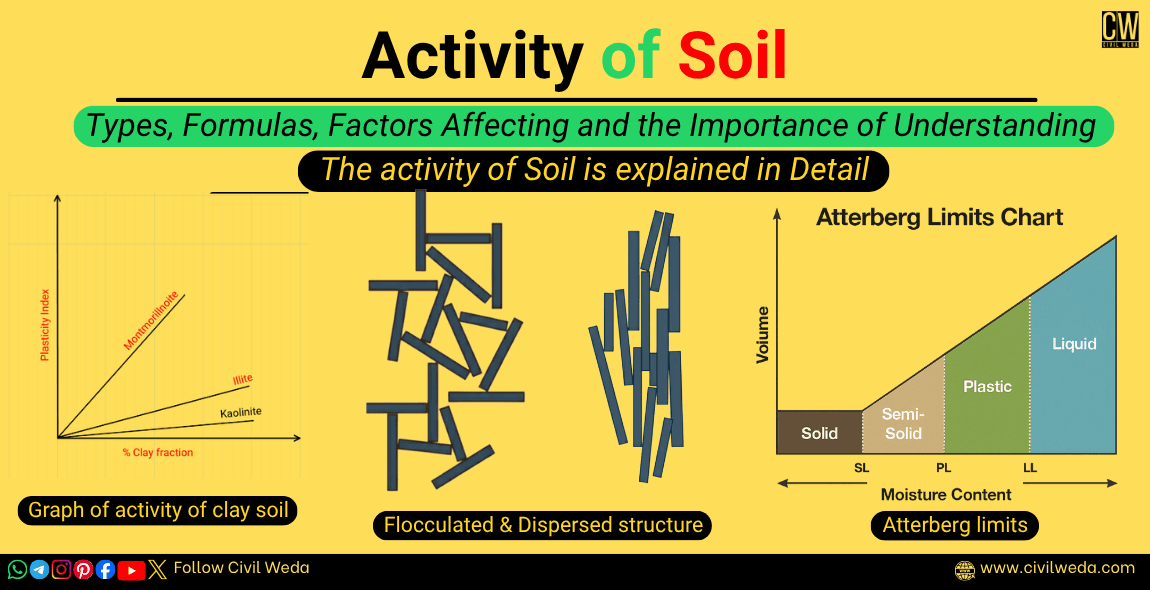
Introduction
In Soil Mechanics, understanding the behaviour of clay soils is one of the most essential tasks for a geotechnical engineer. Clay behaves differently with changes in moisture content, sometimes expanding, shrinking, and this behaviour directly affects the stability of structures built on it.
To describe how reactive or sensitive a clay is to water content, A.W. Skempton (1953) introduced a concept called “Activity of Soil.”
In simple words, the activity of soil tells us how much a clay soil will expand or shrink when it comes in contact with water.
Thus, it becomes a very important parameter for designing foundations, embankments, and pavements on clayey soils.
In this article, we will learn everything about the Activity of Soil, including its definition, formula, classification, factors affecting it, and its importance in foundation engineering, along with real-life examples.
So, let’s begin and understand this fundamental concept in detail without any further delay!🚀
Definition of Activity of Soil
The Activity of Soil (A) is defined as the ratio of the Plasticity Index (PI) to the percentage of clay particles (particles smaller than 2 microns) present in the soil.
Where,
- PI (Plasticity Index) = Liquid Limit (LL) – Plastic Limit (PL)
- Clay fraction = % of particles smaller than 2 microns (0.002 mm)
So, the activity value shows how much the plasticity of soil depends on the amount of clay minerals it has.
For example:
If two soils have the same Plasticity Index, but one has fewer clay particles, that soil will have higher activity, meaning its clay minerals are more reactive (e.g., montmorillonite).
The Sensitivity of Soil is also an important parameter in soil mechanics, which I have explained in detail in another article.👉 You can read the full article on the sensitivity of soil here.
Concept Behind The Activity of Soil
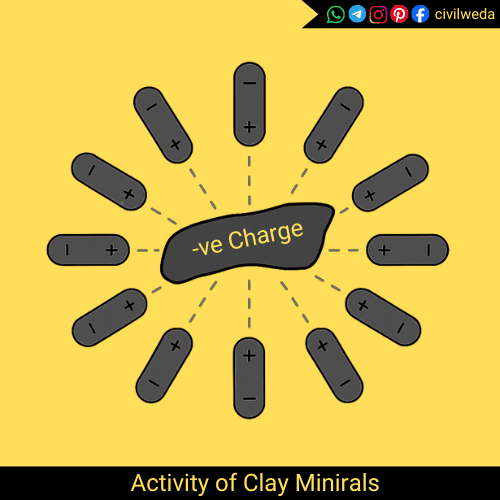
Activity is a measure of the “reactivity” of clay minerals present in the soil. It represents the influence of clay mineralogy on the soil’s plastic behaviour. Highly active soils swell and shrink significantly with changes in moisture, whereas Inactive soils remain relatively stable.
Hence, soil activity links the mineralogical composition (type of clay mineral) to the engineering behaviour (plasticity, swelling, and shrinkage).
Classification of Soil Based on the Activity of Soil
Based on activity, Skempton (1953) proposed the following classification of soils, which is given in the table below:
| Type of Clay | Activity (A) | Nature of Soil | Common Clay Mineral | Example |
| Inactive Clay | A < 0.75 | Low plasticity, less swelling | Kaolinite | Lateritic soil, red soils |
| Normal Clay | 0.75 ≤ A ≤ 1.25 | Medium plasticity | Illite | Moderately plastic clays |
| Active Clay | A > 1.25 | Highly plastic, high swelling | Montmorillonite | Black cotton soil (India) |
Note Points:
- Inactive soils: Stable, suitable for lightweight foundations.
- Normal soils: Moderate swelling, manageable.
- Active soils: Risky for structures because of heaving, cracking, and uneven settlement.
Factors Affecting the Activity of Soil
There are Several physical and chemical factors that control the activity of a soil, which are given below:
1. Type of Clay Mineral
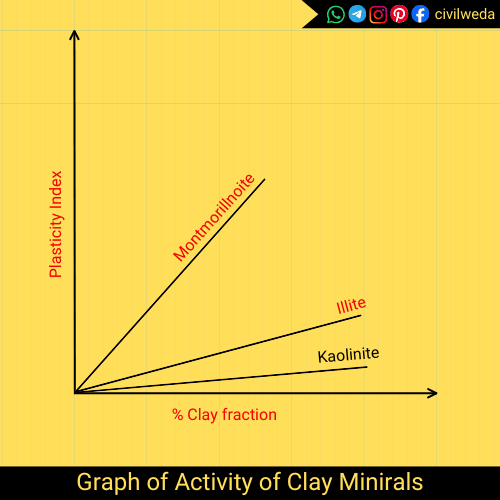
Each clay mineral has a different lattice structure and water absorption capacity:
- Montmorillonite → Highly active (A > 1.25)
- Illite → Moderately active
- Kaolinite → Least active (A < 0.75)
Each clay mineral has a different activity value; a typical graph is shown in the figure.
2. Specific Surface Area
The greater the surface area of clay particles, the more water they can adsorb, increasing activity.
3. Soil Structure (Flocculated or Dispersed)
Flocculated (aggregated) structures show less activity than dispersed structures.
4. Organic Matter
Organic-rich soils often show higher plasticity and thus higher activity.
5. Cation Exchange Capacity (CEC)
Soils with high CEC (like montmorillonite) tend to attract more water molecules, increasing swelling and activity.
Importance of Understanding the Activity of Soil
The Activity of Soil plays a vital role in understanding how clayey soils behave under different moisture conditions. In Geotechnical Engineering, it helps predict whether a soil will expand (swell), contract (shrink), or remain stable, which directly affects the stability and safety of foundations, embankments, and pavements.
Hence, understanding the activity of soil is an essential part of site investigation and soil classification for any civil engineering project.
Importance in Foundation Design
Foundation design is one of the most critical areas where soil activity must be evaluated. Highly active clays absorb water during wet seasons and swell, while they shrink during dry seasons. These volume changes are caused by:
- Differential settlement of foundations,
- Cracks in walls and floors, and
- Tilting or structural distortion over time.
Therefore, engineers must test the activity of the soil before designing foundations. If the soil is highly active, the following preventive measures are adopted:
Note Points
- Using under-reamed piles or deep foundations to avoid direct contact with swelling soil,
- Soil stabilisation using lime, cement, or fly ash, and
- Providing drainage layers around the foundation to control moisture variation.
By identifying soil activity early, engineers can design safe and cost-effective foundations that remain stable for years.
2. Importance in Earth Dams and Embankments
In the construction of earth dams and embankments, the type of soil used in the core or body is very important. If the soil used is highly active, it can undergo swelling and shrinkage when moisture changes, leading to:
- Cracks in the dam core,
- Leakage paths through the embankment, and
- Instability or partial failure of the structure.
To avoid such problems:
- Engineers prefer using low-activity clays for dam cores, or
- Treat the soil with chemical stabilisers to reduce its plasticity and reactivity.
Hence, determining the activity of soil ensures the long-term safety and performance of earth structures.
3. Importance in Pavement Subgrade Design
The pavement subgrade is the bottom layer that supports the entire road structure. If the subgrade soil is active clay, it can heave during wet seasons and shrink during dry seasons. These cyclic changes cause:
- Surface cracking and potholes,
- Uneven road surfaces, and
- Reduced pavement life.
To minimise these effects:
- Engineers stabilise the subgrade with lime or cement,
- Use granular sub-base layers for drainage, and
- Provide proper moisture control measures.
Therefore, understanding soil activity helps in designing durable and stable pavements that can withstand seasonal moisture changes.
Read more Civil Engg Topics
- Timber
- Chlorination of water
- Seasoning of Timber
- Difference between Tar and Bitumen
- Types of soil
- Atterberg Limits
- Compass Survey
- Factors affecting per capita demand
- Drip Irrigation
Conclusion
The Activity of Soil is a key concept in Soil Mechanics that connects the plastic behaviour of soils with their mineral composition. It was introduced by A.W. Skempton (1953) to help engineers understand how the type and amount of clay minerals affect the swelling and shrinkage behaviour of soil.
By analysing the Plasticity Index (PI) and the percentage of clay-sized particles, engineers can determine whether a soil is inactive, normal, or active and accordingly predict how it will behave under changing moisture conditions.
FAQs
1. Who introduced the concept of Soil Activity?
The concept of Activity of soil is given by A.W. Skempton in 1953.
2. What are the units and dimensions of the Activity of Soil?
The activity of Soil is a unitless and dimensionless parameter.
3. What is A value for highly active soil?
For highly active soil, A value is greater than 1.25.
Thank You for Reading! 🙏
We hope this article helped you clearly understand the Activity of Soil in civil engineering. If you found this complete article useful, please share it with your friends and university students. For more informative posts on civil engineering topics, stay connected with Civil Weda. 🚀