
1. Introduction
In coarse-grained soils such as sand and gravel, the strength and behaviour mainly depend on how closely the soil particles are packed together. Unlike clayey soils, their properties are not much affected by water content, but by the degree of compactness between particles.
To express this compactness numerically, geotechnical engineers use an important parameter known as the Density Index, which is also called Relative Density. It indicates how dense or loose a granular soil is when compared with its loosest and densest possible conditions.
A higher Density Index means the soil is more compact, stronger, and less compressible, while a lower Density Index indicates loose soil with low strength. Therefore, it plays a key role in foundation design, compaction control, and slope stability analysis of sandy soils.
In this article, we will learn the complete concept of the Density Index of Soil, including its definition, formula, factors affecting, range, and significance in a simple and exam-oriented way. So, let’s get started without any further delay!
2. Definition of Density Index (Relative Density)
Density Index (ID) is a measure of the degree of compactness of a granular soil such as sand. It tells us how dense or loose the soil is when compared with its loosest and densest possible states.
In other words:
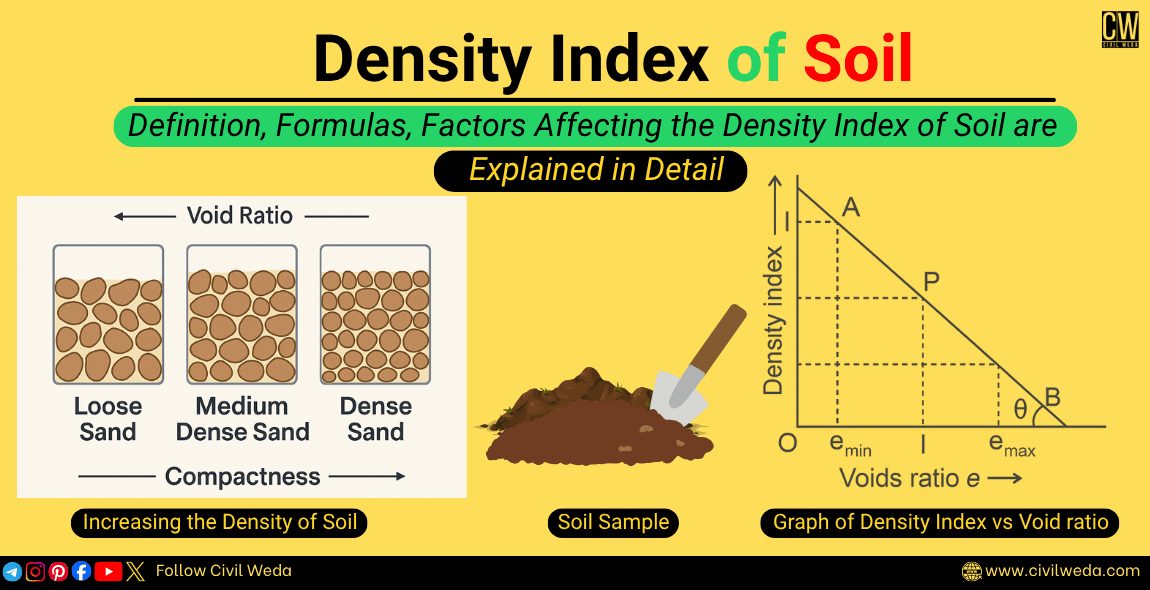
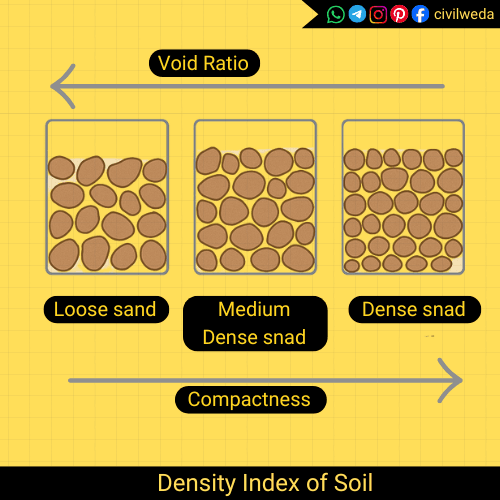
The Relative density represents how close the existing void ratio of soil is to its minimum possible void ratio. It means that when the relative density of the soil increases, the void ratio decreases. Atypical infographic of relative density shown in the figure:
When the soil is in its loosest state, the Density Index is 0%, and when it is in its densest state, the Density Index becomes 100%. Thus, it gives a numerical measure of compactness between these two extreme states.
3. Formula of Density Index
In terms of void ratio
In terms of void ratio, the formula of relative density is given by:
Where:
- emax = Void ratio of soil in the loosest state
- emin =Void ratio of soil in densest state
- e = Void ratio of soil in natural state
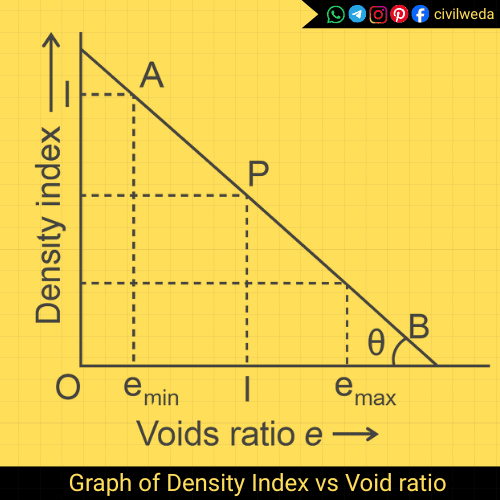
A typical graph between Relative density and void ratio of soil is shown in the figure:
In terms of Unit Weight
In terms of Unit Weight, when the void ratios (e) are not available, the Density Index can also be expressed using the dry unit weights of soil.
Where:
- = Dry unit weight of soil in natural condition
- = Maximum dry unit weight (densest state)
- = Minimum dry unit weight (loosest state)
Meaning of the Formula:
For very loose sand, the relative density is zero, and for very dense sand relative density becomes 100% i.e.
When the soil is very loose, →
When the soil is very dense, →
This form of equation is widely used in field compaction control and relative density tests for sand, where densities are measured directly.
3. Range of Density Index and Soil Condition
The value of the Density Index (ID) helps engineers understand how compact or loose a granular soil deposit is. It provides a clear classification of soil conditions ranging from very loose to very dense.
| Soil Condition | Density Index (ID) | Engineering Behavior |
| Very Loose | 0 – 15 % | Very low strength, high compressibility, may lead to large settlements |
| Loose | 15 – 35 % | Low bearing capacity, prone to liquefaction |
| Medium Dense | 35 – 65 % | Moderate strength and stiffness |
| Dense | 65 – 85 % | High shear strength, less compressible |
| Very Dense | 85 – 100 % | Very high strength, low compressibility, stable foundation support |
Note Points
- As the Density Index increases, the soil becomes denser and stronger.
- High-density index means particles are tightly packed, resulting in fewer voids and higher shear resistance.
- Low Density Index indicates loose packing, meaning the soil is weak and more compressible under loads.
4. Significance / Importance of Density Index
The Density Index (ID) is a very important parameter in Geotechnical Engineering, especially for sandy and granular soils. It helps engineers understand how compact or loose a soil deposit is, which directly influences its strength, compressibility, and stability.
In practical terms, the Density Index connects the microscopic arrangement of soil particles with the macroscopic behaviour of the soil under loads.
a. Determines the Degree of Compactness
The Relative density provides a quantitative measure of the compactness of coarse-grained soils. It helps to classify soil as very loose, loose, medium dense, dense, or very dense. This information is useful for both laboratory analysis and field compaction control.
b. Useful in Foundation Design
The bearing capacity and settlement characteristics of sandy soils depend largely on their Density Index.
- Higher ID (Dense Sand) → Greater interlocking, higher strength, and less settlement.
- Lower ID (Loose Sand) → Weak structure, high compressibility, and greater risk of failure.
Hence, the Density Index plays a key role in deciding the safe load-carrying capacity of foundations.
c. Indicates Shear Strength of Soil
A higher Density Index means particles are closely packed, creating more interlocking and frictional resistance between grains. As a result, the angle of internal friction (ϕ) increases, which improves the shear strength of the soil.
d. Control for Field Compaction
During field compaction works, such as:
- Highways & Runways
- Earth Dams
- Retaining Wall Backfills
- Embankments and Subgrades
The measured dry unit weight (γd) of the compacted layer is compared with its maximum and minimum dry unit weights. This comparison gives the Density Index, confirming whether the desired degree of compaction has been achieved or not.
e. Assessment of Liquefaction Potential
Loose sands having a low Density Index (below 35%) are more prone to liquefaction during earthquakes. Therefore, knowing the Density Index of a soil deposit is essential for seismic site evaluation and earthquake-resistant design.
f. Correlation with Other Engineering Properties
Density Index is often correlated with several soil parameters, such as:
- Angle of Internal Friction (ϕ)
- Modulus of Elasticity (E)
- Compressibility and Permeability
These correlations help engineers estimate various soil properties indirectly from Density Index values.
5. Factors Affecting the Density Index of Soil
The Density Index (ID) of granular soil depends on several physical and environmental factors that influence the packing of soil grains.
These factors control how loosely or densely the particles can be arranged under different conditions.
a. Grain Size Distribution
- Soils having well-graded particles (a wide range of sizes) can pack more efficiently because smaller grains fill the voids between larger ones.
- Hence, well-graded sands show higher ID values.
- Uniformly graded soils (all particles of nearly the same size) remain loose, resulting in a lower Density Index.
b. Particle Shape and Angularity
- Angular or irregular-shaped grains interlock better, leading to higher density.
- Rounded particles (like river sand) roll over each other easily and give a lower density.
- Thus, particle shape greatly affects the achievable maximum and minimum void ratios.
c. Compaction Effort
- The greater the compactive effort (like vibration, tamping, or rolling), the denser the soil becomes.
- Proper compaction reduces the voids between particles and increases the dry unit weight, resulting in a higher Density Index.
d. Moisture Content
- A small amount of moisture acts as a lubricant among soil grains, helping them rearrange into a denser state.
- However, too much water may create pore pressure and prevent densification.
- Hence, there exists an optimum moisture condition for maximum density.
e. Method of Deposition or Placement
- The way the soil has been placed or deposited (naturally or artificially) affects its structure.
- Water-deposited sands are usually loose.
- Wind-blown or compacted fills tend to be denser.
- Field conditions, like vibration due to traffic or machinery, can also change the Density Index over time.
f. Stress History and Overburden Pressure
- With time, overburden stress and vibration cause rearrangement of grains, gradually increasing the density.
- This is why old sand deposits are often found in denser conditions than recently placed fills.
Read more Civil Engg Topics
- Timber
- Chlorination of water
- Seasoning of Timber
- Difference between Tar and Bitumen
- Types of soil
- Atterberg Limits
- Compass Survey
- Factors affecting per capita demand
- Drip Irrigation
6. Conclusion
The Density Index of Soil is one of the most important parameters used to describe the compactness of granular soils, especially sands. It provides a clear picture of how the soil particles are arranged, whether the soil is loose, medium dense, or dense, and how that affects its strength, compressibility, and stability.
A higher Density Index means the soil is well compacted, stronger, and more stable. while a lower Density Index indicates loose soil that may settle more and have lower bearing capacity.
In geotechnical engineering, the Relative density acts as a bridge between theory and field performance, helping engineers evaluate foundation safety, compaction quality, and liquefaction risk.
In short: “The Density Index tells us how tightly the sand grains are packed, and that simple number decides how strong the ground beneath our structures really is.”
7. FAQs on Density Index
1. For which type of soil is the Relative density applicable?
The Relative density is applicable only for coarse-grained soils, mainly sands, where the behaviour depends on particle packing.
It is not used for fine-grained soils like silts and clays.
2. What is the significance of the Density Index in field work?
It helps to:
Evaluate field compaction quality, Estimate bearing capacity and shear strength, and assess liquefaction potential in sandy soils.
Thus, it is an essential parameter for foundation design and soil stability assessment.
3. What is the Relative density in Soil Mechanics?
Relative density (ID) is a measure of the degree of compactness of a granular soil, expressed as a percentage comparing its natural void ratio with the maximum and minimum void ratios.
Thank You for Reading! 🙏
We hope this article helped you clearly understand the Density Index in civil engineering. If you found this complete article useful, please share it with your friends and university students. For more informative posts on civil engineering topics, stay connected with Civil Weda. 🚀