

Introduction
Water demand estimation is very important for planning and running water supply systems. As the population increases and lifestyles change, the need for water also grows. In India, agriculture uses more than 80% of the total water, but due to urbanization and industrial growth, domestic, commercial, and institutional water demand is also rising quickly. (For example, in the Delhi-NCR region, the per capita water demand has increased in the last ten years.)
In this article, we will explain the main types of water demand, simple formulas used for estimation, and some modern approaches, such as forecasting methods and real-time monitoring.
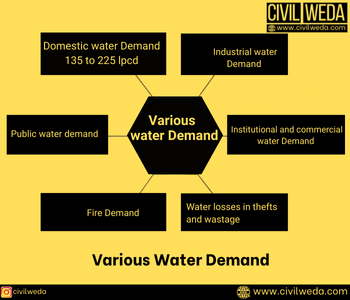
Water Demand
Estimation of water demand is a key factor in designing an efficient water supply system. In India, agriculture alone consumes more than 80% of available water, while the remaining portion is utilized to meet domestic, industrial, and other demands. The improvement of lifestyle and associated industrial development of a nation push up the per capita demand for water.
Types of Water Demand
Water demand can be divided into several categories depending on the purpose of use. The main types, with typical IS references, are:

Domestic Water Demand
This includes water for drinking, cooking, bathing, washing, cleaning, and gardening. Typical values used for design (subject to local variation) are: 135–200 lpcd, depending on lifestyle and facilities. IS:1172–1993 (Code of basic requirements for water supply, drainage, and sanitation) and CPHEEO manuals are commonly used for guidance.
Industrial Water Demand
Water required by industries (textile, paper, chemical, etc.) varies widely by industry type, production scale, and reuse practices. Industry-specific standards and CPHEEO guidelines are normally referred to for design values.
| Industry Type | Water Demand |
|---|---|
| Automobile Industry | ~40 kiloliters per vehicle |
| Fertilizer Industry | 80 – 200 kiloliters per tonne |
| Paper & Pulp Industry | 200 – 400 kiloliters per tonne |
| Petroleum Refinery | 1 – 2 kiloliters per tonne |
| Textile Industry | 80 – 140 kiloliters per tonne |
Institutional and Commercial Water Demand
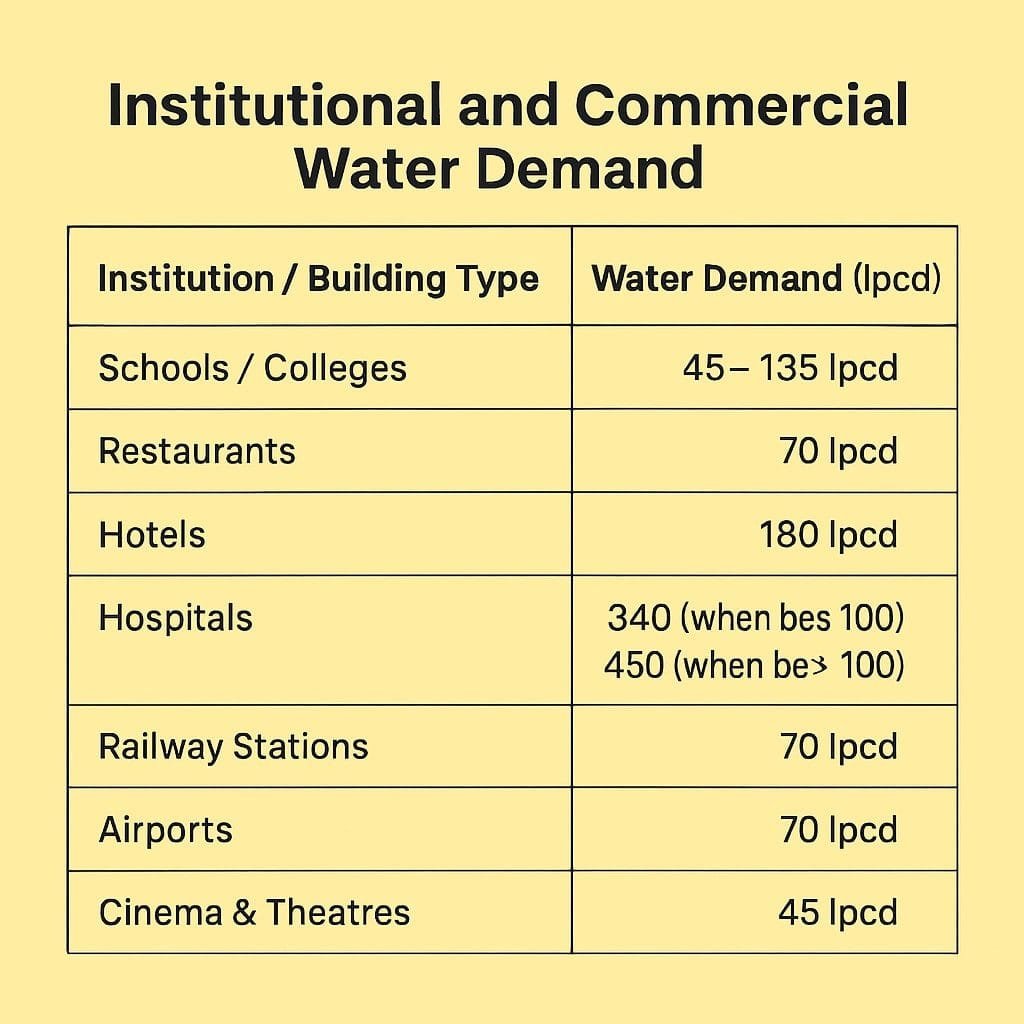
This includes schools, colleges, offices, hotels, restaurants, hospitals, railway stations, and airports. Typical design values given in the table below:
| Institution / Building Type | Demand in (lpcd) |
|---|---|
| Schools / Colleges | 45 – 135 lpcd |
| Restaurants | 70 lpcd |
| Hotels | 180 lpcd |
| Hospitals | 340 lpcd (when beds < 100) 450 lpcd (when beds > 100) |
| Railway Stations | 70 lpcd |
| Airports | 70 lpcd |
| Offices | 45 lpcd |
| Cinema & Theatres | 15 lpcd |
Public Water Demand
Public uses like parks, street washing, public fountains, and community uses are covered under municipal / CPHEEO guidance. Values depend on the area of parks, planting density, and municipal policies.
Fire Fighting Demand
Fire demand is estimated using empirical approaches and firefighting standards (Kuchling’s, Buston’s rules, and local fire codes). Always follow local fire authority requirements and IS guidance where applicable.
Water Losses and Unaccounted-for Water
Transmission, distribution losses, leakages, and illegal connections typically account for 10–20% (or more) of supply. CPHEEO and water utilities publish recommended targets for reduction and acceptable levels. On average, a per capita demand of 20 lpcd is usually considered to be enough to meet such commercial and institutional water requirements. Institutional and commercial water demand may be as high as 50 lpcd for highly commercial cities. Some of them are listed below:
Demand for Public Uses:
This includes water requirements for Park gardening, washing of roads, etc. A nominal amount not exceeding 5% of total consumption may be provided to achieve this demand. Around 10 lpcd is usually added to this account while computing the total water consumption for the cities or towns.
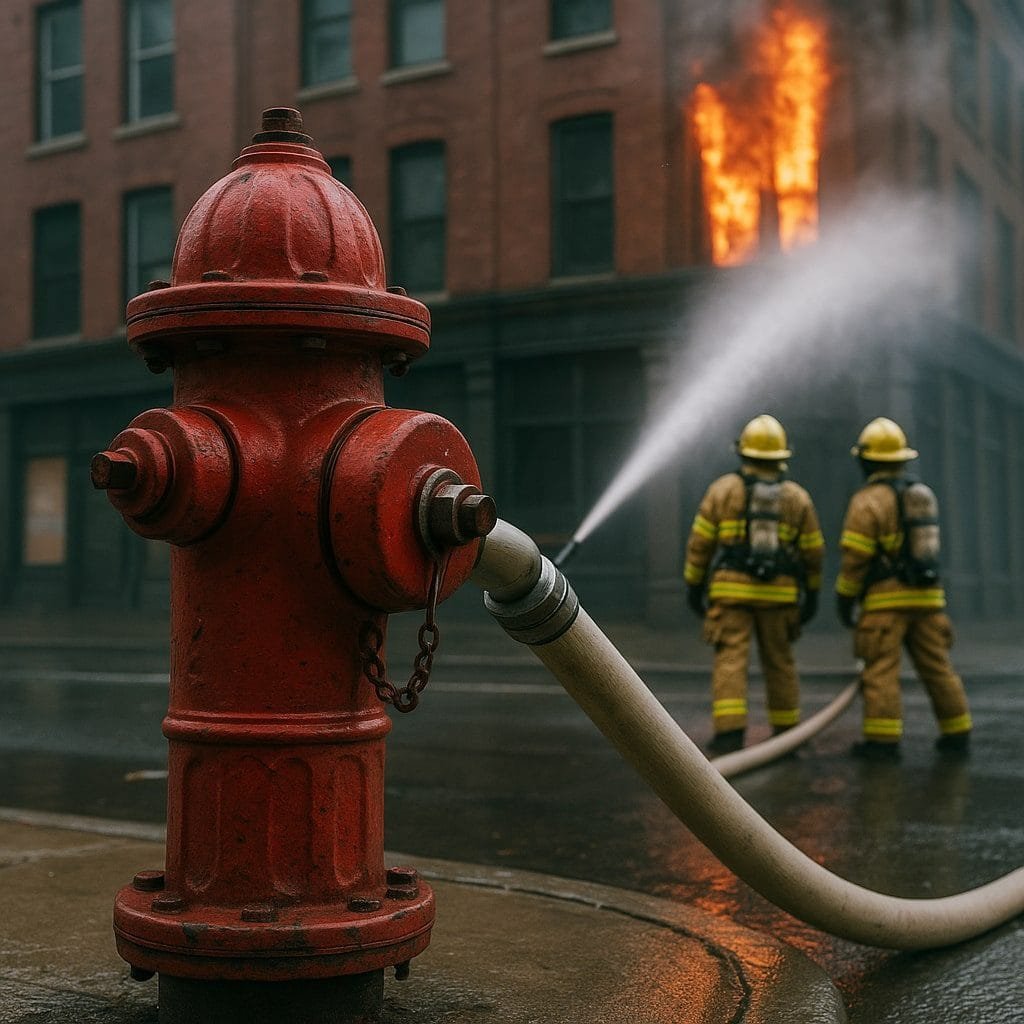
Water Demands for Fire:
The quantity of water required for extinguishing fire is not very large. For the total amount of water consumption for a city of 50 lakhs population, it hardly comes out to around 1 lpcd water required for fire demand, but this water should be easily available and always kept stored in a storage reservoir, as the quantity of water required is a very less duration.
There are many empirical formulas for estimating the water required for the Fire demand, Such as Kuchling’s formula, Freeman’s formula, Buston’s formula, etc.
Water required to compensate for losses in theft and wastage:
This includes the water lost in leakage due to bad plumbing or damaged meters, stolen water due to unauthorized water connections, and other losses and wastage. These losses should be taken into account while estimating the total requirement of water, even in the best-managed water work. The amount may be as high as 15% of total consumption, which is nearly 55 lpcd.
Read more Civil Engg topics
- Chlorination of water
- Per Capita Water Demand
- Advantages and Disadvantages of Sprinkler Irrigation
- Advantages and Disadvantages of Irrigation
- Drip Irrigation
- Viscosity
- Surface Tension
Conclusion
Water demand is one of the most important factors in designing and managing water supply systems. Understanding its different types—domestic, industrial, institutional, public, fire, and losses—helps engineers and planners estimate requirements more accurately. By following standards such as IS:1172–1993 and CPHEEO guidelines, water supply projects can be designed to meet present as well as future needs. Proper estimation and planning ensure sustainable use of water resources and a reliable supply for communities.
FAQs on Water Demand
Q1. What is water demand in water supply engineering?
Water demand refers to the total quantity of water required by a community or industry for domestic, industrial, institutional, public, and other purposes.
Q2. What are the main types of water demand?
The main types are domestic demand, industrial demand, institutional and commercial demand, public demand, fire demand, and water losses/wastage.
Q3. What is the average domestic water demand in India?
As per IS:1172–1993 and CPHEEO guidelines, the average domestic water demand is 135 liters per capita per day (lpcd) for towns and cities.
Q4. How is fire demand estimated?
Fire demand is estimated using empirical formulas such as Kuchling’s, Freeman’s, or Buston’s formula, depending on population and city type.
Q5. Why is demand estimation important?
It is important for designing water supply systems, ensuring adequate storage, planning future requirements, and promoting sustainable use of resources.
Thank You for Reading! 🙏
We hope this article helped you clearly understand the Water Demand in civil engineering. If you found this complete article useful, please share it with your friends and university students. For more informative posts on civil engineering topics, stay connected with Civil Weda. 🚀