
Introduction
Understanding the behaviour of fluids at high speeds is one of the most important parts of fluid mechanics, especially when the flow becomes compressible. Among all the parameters used to describe such flows, the Mach Number is the simplest yet most powerful one. It tells us whether the flow is slower, equal to, or faster than the speed of sound. This concept is widely used in aerodynamics, aerospace engineering, compressible flow, nozzles, wind tunnels, and even in many real-life engineering applications.
Mach Number is simply a ratio, but it gives deep insights into the flow:
- Is the flow slow or fast?
- Will the flow create a shock wave?
- Is the flow compressible or incompressible?
- Will the pressure change suddenly?
A student preparing for semester exams, GATE, SSC JE, or any competitive exam should understand this topic very clearly.
In this article, we will learn the definition, formula, types, Mach angle, shock waves, and applications of Mach Number in a simple and easy to understand language. So let’s get started without any further delay.
What Is Mach Number?
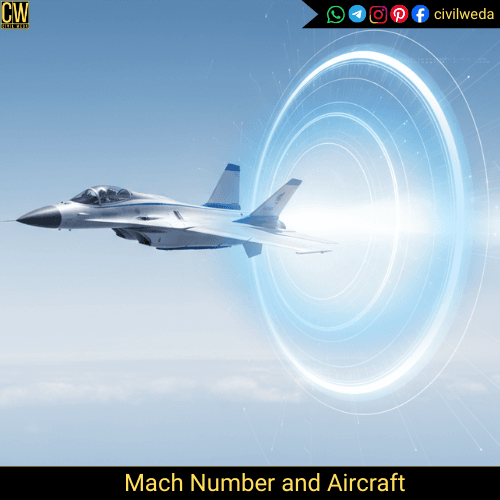
The concept of Mach Number was introduced by Austrian physicist Ernst Mach, who studied high-speed motion, shock waves, and the behaviour of objects moving faster than sound.
Mach Number is the ratio of the flow velocity to the speed of sound in that medium.
It tells us how fast a fluid or object is moving as compared to the speed of sound. If the Mach Number is less than 1, the flow is subsonic; if it is more than 1, the flow becomes supersonic.
Formula of Mach Number
The formula of Mach Number is given as:
Where,
- V = velocity of the object or fluid
- c = speed of sound in the same medium
The speed of sound depends on the properties of the medium, especially its temperature.
Speed of Sound in Fluids
The speed of sound in air or any gas is calculated using the formula:
Where,
- γ (gamma) = ratio of specific heats
- R = Gas constant
- T = Absolute temperature
Important points to remember:
- The speed of sound increases with increasing temperature.
- In hot air, sound travels faster.
- In cold air, sound travels more slowly.
- This is why Mach Number depends on temperature.
At a temperature around 20°C, the speed of sound in air is approximately 343 m/s.
Mach Angle and Mach Cone
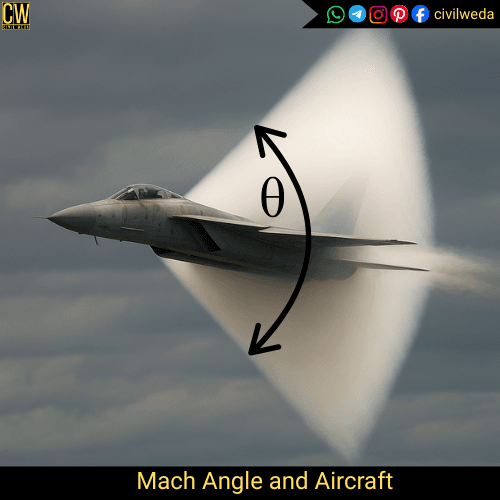
Mach Angle and Mach Cone are two important concepts related to supersonic flow. When an object moves faster than the speed of sound, pressure waves cannot travel ahead of it. Instead, these waves combine and form a cone-shaped region behind the moving object. This region is known as the Mach Cone, and the angle formed at its edge is called the Mach Angle.
Mach Angle is the angle formed between the direction of motion of a supersonic object and the edge of the Mach cone created by the pressure waves. It represents how tightly the pressure waves are compressed behind the object.
Formula of Mach Angle
Mach Angle (θ) is given by:
Where:
- θ = Mach Angle
- M = Mach Number
Types of Flow Based on Mach Number
Mach Number helps us classify different flow regimes based on how fast the fluid or object is moving compared to the speed of sound. Each flow type shows different behaviour in terms of pressure, density, and shock formation. Understanding these flow ranges is very important for fluid mechanics, aerodynamics, and exam preparation.
1. Subsonic Flow (M < 1)
In subsonic flow, the speed of the fluid is less than the speed of sound. Density changes are very small, so compressibility effects can usually be ignored. The flow remains smooth, stable, and predictable.
Example: Airflow around a car or low-speed aircraft.
2. Sonic Flow (M = 1)
In sonic flow, the velocity of the fluid becomes equal to the speed of sound. Under these conditions, a phenomenon called choked flow can occur, where the flow cannot increase its speed further even if the pressure is increased. Wave patterns also start forming at this stage.
3. Transonic Flow (M = 0.8 – 1.2)
Transonic flow is a mixed-flow zone where some regions of the fluid become subsonic while other regions turn supersonic. This creates unstable and highly fluctuating flow conditions. Shock waves begin to form, making the flow more complex to analyse.
Example: Aircraft crossing the sound barrier.
4. Supersonic Flow (M > 1)
In supersonic flow, the speed of the fluid becomes greater than the speed of sound. Strong shock waves form because pressure disturbances cannot move forward. Compressibility effects are significant, and the flow behaviour changes rapidly.
Example: Fighter jets like F-16 or Sukhoi.
5. Hypersonic Flow (M > 5)
Hypersonic flow occurs at extremely high Mach Numbers. At this stage, the temperature rise is very large, and in some cases, chemical reactions may start in the air due to intense heat. The design of vehicles in this regime requires advanced materials and special aerodynamic shapes.
Example: Spacecraft during re-entry.
Shock Waves and Mach Number
Shock waves are a very important feature of high-speed flows. A shock wave is a thin region where pressure, temperature, and density suddenly increase.
Shock waves occur when:
- Mach Number becomes greater than 1
- Flow is supersonic
- Pressure disturbances cannot move ahead of the object
Sonic Boom:
When a supersonic aircraft passes overhead, a loud, explosive sound known as a sonic boom is heard. This sound is produced due to strong shock waves.
Examples of shock-wave-producing objects:
- Bullets
- Fighter jets
- Rockets
- Whips (the cracking sound is a mini sonic boom)
Applications of Mach Number

Mach Number is widely used in various engineering fields, especially where high-speed flow and compressibility effects are important. It helps engineers understand flow behaviour, predict shock waves, and design aerodynamic shapes more effectively.
1. Aircraft and Aerodynamics
Mach Number plays a key role in aircraft design. It determines whether the aircraft is flying in subsonic, transonic, or supersonic conditions. Based on Mach Number, engineers design the aircraft nose, wings, and control surfaces to reduce drag and improve stability at high speeds.
2. Compressible Flow Analysis
In compressible flow, density changes cannot be ignored. Mach Number helps in analysing flows through nozzles, diffusers, venturis, and convergent-divergent (C-D) nozzles. It also indicates whether the flow is choked, which is important for jet engines and rockets.
3. Rocket and Missile Technology
Rockets and missiles often travel at supersonic and hypersonic speeds. Mach Number helps in predicting shock waves, aerodynamic heating, pressure distribution, and structural loads. Without Mach Number analysis, safe high-speed flight is not possible.
4. High-Speed Trains and Transport Systems
Modern high-speed trains create strong pressure waves when entering tunnels. Mach Number helps engineers design smooth train nose shapes and tunnel openings to reduce noise, vibration, and passenger discomfort.
5. Wind Tunnel Testing
Wind tunnels simulate different flow regimes: subsonic, transonic, and supersonic. Mach Number decides the test conditions. It ensures that models of aircraft, cars, and buildings experience realistic aerodynamic forces before real-world use.
6. Civil and Mechanical Engineering Applications
Even in civil engineering, Mach Number helps in analysing wind action on tall buildings, bridges, and structures exposed to extreme wind speeds. In mechanical engineering, it is used for studying flow in compressors, turbines, and pipelines, where high-speed flow may cause compressibility effects.
7. Spacecraft and Re-entry Vehicles
During re-entry, spacecraft travel at extremely high Mach Numbers (Mach 20–25+). Mach No helps in predicting intense aerodynamic heating, shock wave formation, and material selection for thermal protection systems.
Read more Civil Engg Topics
- Capillary action
- Timber
- Chlorination of water
- Seasoning of Timber
- Difference between Tar and Bitumen
- Types of soil
- Atterberg Limits
- Compass Survey
- Factors affecting per capita demand
- Drip Irrigation
- Pile Foundation
Conclusion
Mach Number is a simple ratio, yet it provides deep and meaningful information about the nature of flow. It helps engineers determine whether the flow is subsonic, sonic, transonic, supersonic, or hypersonic. The formula is straightforward, but its application is vast—from aircraft and rockets to wind tunnels and high-speed trains.
Understanding Mach No is essential for compressible flow analysis and for predicting shock waves, Mach angle, and the overall behaviour of high-speed fluids. With a solid grip on this concept, any engineering student can confidently solve numerical problems and also understand real-world applications related to high-speed motion.
Who introduced the concept of Mach Number?
The concept of Mach Number was introduced by Austrian physicist Ernst Mach, who studied high-speed motion and shock waves.
What is the speed of sound in air?
At around 20°C, the speed of sound in air is approximately 343 m/s.
What is subsonic flow?
Subsonic flow occurs when the Mach Number is less than 1.
What is supersonic flow?
Supersonic flow occurs when the Mach Number is greater than 1.
Can Mach Number be zero?
Yes! When the object is not moving relative to the medium, its Mach Number is zero.
Thank You for Reading! 🙏
We hope this article helped you clearly understand the Portland Cement in civil engineering. If you found this complete article useful, please share it with your friends and university students. For more informative posts on civil engineering topics, stay connected with Civil Weda. 🚀