

Introduction
As we know, Pressure measurement is an important topic in fluid mechanics. It is often asked in exams such as SSC JE, GATE, and state PCS competitive exams, including BPSC AE, etc.
A manometer is a very simple device that is used to measure the pressure of a fluid. It works on the basics of fluid statics, so it is easy to understand.
In this article, we will discuss the definition, types, working principle, formula, and applications of a manometer in a simple and easy language. So let’s get started…
What is a Manometer?
This is a device used to measure the pressure of a fluid. It measures pressure by balancing it against a column of liquid such as water or mercury.
In simple words, we can say this shows pressure by the difference in the height of the liquid column. When pressure is applied, the liquid ( Manometric Fluid) inside the manometric tube moves up and down. This movement creates a height difference, which is used to calculate pressure (P = ρgh).
A manometer works on the principle of hydrostatic pressure. According to this principle, the pressure of a fluid depends on height and density.
Manometers are simple in design and do not require electricity. So, they are widely used in laboratories, pipelines, and various engineering systems.
Working Principle of a Manometer
The working Principle of a manometer is based on the principle of hydrostatic pressure. It measures pressure by comparing the height difference with a reference pressure, usually atmospheric pressure.
When pressure is applied to the fluid, the liquid inside the manometric tube moves up and settles at a new level. This creates a difference in the height of the liquid column on both sides.
This height difference is directly related to the pressure difference. A larger difference in height means a higher pressure and vice versa.
In simple words, this shows pressure by indicating how much the liquid level rises or falls inside the tube.
Measurement of Pressure
The pressure measured by a manometer is calculated using a simple formula: P=ρgh.
- Where,
- P = Pressure
- ρ (rho) = Density of the fluid
- g = Acceleration due to gravity
- h = Height difference of the liquid column
This formula shows that pressure depends on the height of the liquid (Manometric Fluid) column and the density of the fluid used.
If the height increases, the pressure also increases. Similarly, a denser fluid like mercury will show a higher pressure for the same height compared to water.
Because of this simple relation, it is easy to use and very useful in solving fluid mechanics problems.
Types of Manometer

It is mainly classified into two types based on their use:
A. Simple Manometer
A simple manometer is used to measure the pressure at a single point in a fluid. It is classified as…
1. Piezometer
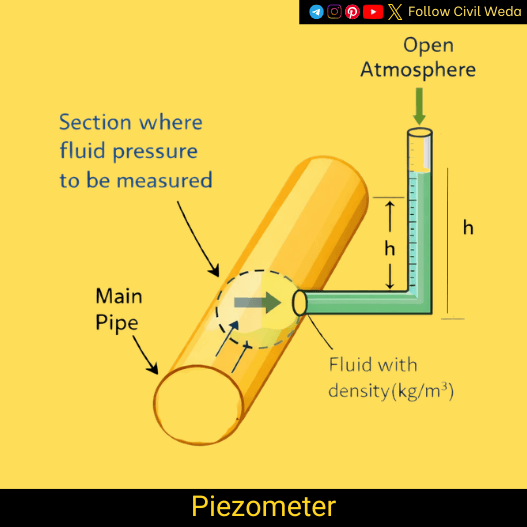
A piezometer is a simple vertical tube connected to a pipe or vessel to measure liquid pressure. When pressure is applied, the liquid rises in the tube, and the height of the liquid column indicates the pressure. As shown in the figure:
Important Points
👉 It is suitable only for liquids and can’t be used for gases.
👉 It is mainly used for low-pressure measurement.
👉 It cannot measure negative pressure (vacuum).
👉 It is commonly used in open channel flow and water supply systems.
👉 The diameter of the tube is usually 5 mm to 12 mm, which helps in clear reading and avoids the capillary effect.
2. U-tube Manometer
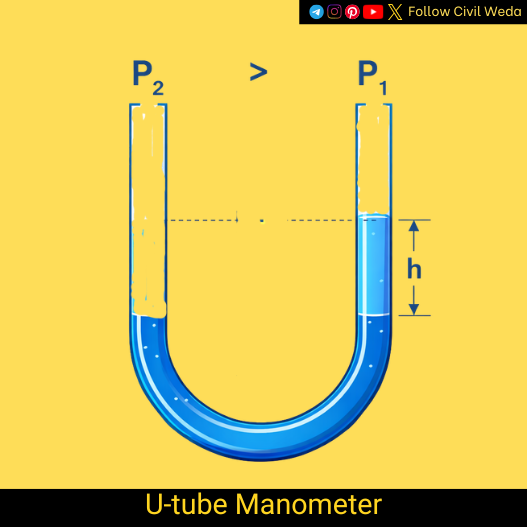
A U-tube manometer consists of a U-shaped glass tube filled with a liquid such as mercury or water. One end is connected to the pressure source, and the other end is open to the atmosphere or connected to another point, as shown in the figure.
Important Points
👉 It measures pressure by the difference in liquid levels in both arms.
👉 It is simple in design and easy to use.
👉 It can measure both positive and negative pressure.
👉 It is widely used in laboratories and basic fluid experiments.
👉 The diameter of each limb is generally 6 mm to 12 mm for proper observation of liquid levels.
3. Single Column Manometer
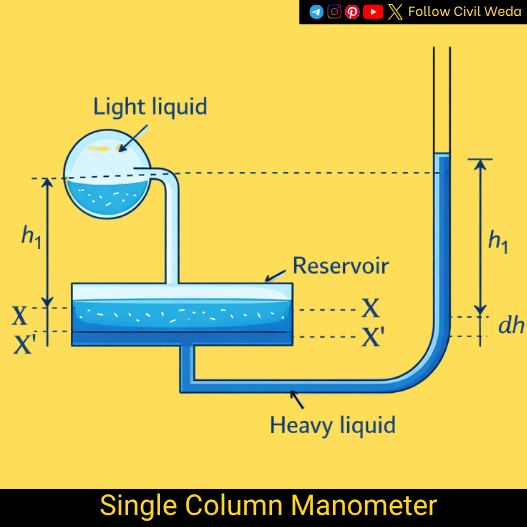
A single-column manometer has one large reservoir and one narrow tube. When pressure is applied, the liquid level in the narrow tube changes significantly, making it easier to read small differences, as shown in the figure.
Important Points
👉 It is more sensitive than a U-tube manometer.
👉 It provides more accurate readings for small pressure changes.
👉 It reduces reading errors due to the large reservoir.
👉 It is used where precise measurement is required.
👉 The tube diameter is about 5 mm to 10 mm, while the reservoir diameter is much larger (25 mm to 50 mm) to minimise level change in it.
👉 These are easy to use and commonly used in basic fluid measurements.
👉 A single-column manometers are two types: one is a single-column vertical manometer, and the other is a single-column inclined manometer.
B. Differential Manometer
A differential manometer is used to measure the pressure difference between two points. It is classified as…
1. Differential U-tube Manometer
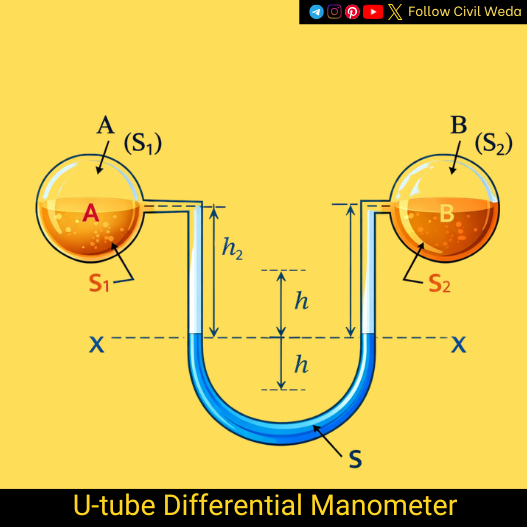
A differential U-tube manometer is used to measure the pressure difference between two points in a system. Both ends of the tube are connected to two different points, and the difference in liquid levels shows the pressure difference.
Important Points
👉 It is useful in measuring pressure drop in pipes.
👉 It can be used for both liquids and gases.
👉 It is commonly used in flow measurement systems.
👉 It is simple but very effective for the comparison of pressures.
👉 The diameter is usually 6 mm to 12 mm in both limbs for accurate measurement.
2. Inverted U-tube Manometer
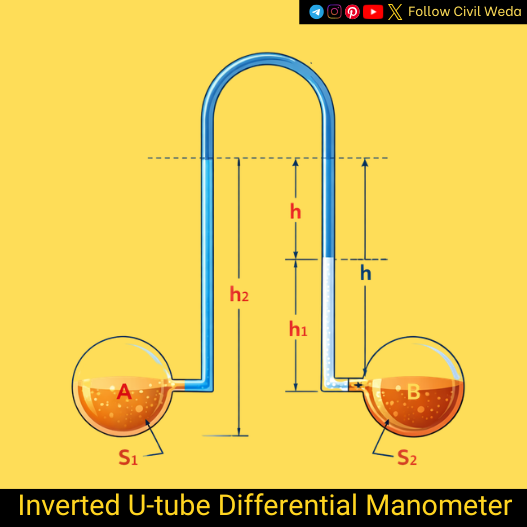
An inverted U-tube manometer uses a lighter liquid (like oil or air) instead of a heavier liquid. It is mainly used to measure small pressure differences between two points.
Important Points
👉 It is highly sensitive to small pressure variations.
👉 It is commonly used for gas pressure measurement.
👉 It is not suitable for large pressure differences.
👉 It gives more accurate results for low-pressure systems.
👉The diameter is slightly larger (8 mm to 15 mm) to maintain the stability of the lighter fluid.
👉 These are mainly used in advanced applications where pressure comparison is required.
Applications of the Manometer, which is given below
Manometers are widely used in both laboratory and practical engineering applications. Their simple design and accuracy make them very useful.
👉 They are used to measure pressure in pipes id piplins.
👉 They are commonly used in laboratories for fluid experiments.
👉 They are used in HVAC ( Heating, Ventilation, and Air Conditioning ) systems to measure air pressure.
👉 They help in measuring gas pressure in different systems.
👉The same principle is also used in medical devices like blood pressure measurement or Disadvantages
Advantages:
They have several advantages due to their simple design and operation. which is given below
👉 Simple construction and easy to use
👉 Low cost compared to other pressure measuring devices
👉 High accuracy for pressure measurement
👉 No electricity or external power required
👉 Reliable for laboratory and basic engineering use
Disadvantages:
Along with advabut it isgs, it has some limitations or Disadvantages
👉 Bulky in size and requires more space
👉 Not suitable for very high-pressure measurement
👉 Slow response compared to digital instruments
👉 Not convenient for continuous monitoring
👉 Handling of liquids like mercury can be risky
Read more Civil Engg Topics
Viscosity
Surface tension
Chlorination of water
Drip Irrigation
Difference between Tar and Bitumen
Conclusion
A manometer is one of the most basic and useful devices in fluid mechanics for measuring pressure. It works on the simple principle of hydrostatic pressure, which makes it easy to understand even for beginners.
Despite its simple construction, it provides accurate results and is widely used in laboratories, pipelines, and various engineering systems. Different types of manometers are used depending on the requirement, such as measuring pressure at a point or finding the pressure difference between two points.
Although modern digital devices are available, but it is still important because of their reliability, low cost, and ease of use. They also help in building a strong understanding of pressure concepts.
Overall, learning about manometers is essential for both practical applications and competitive exams like SSC JE, GATE, and BPSC, as questions are frequently asked from this topic.
1. What is the principle of a manometer?
A manometer works on the principle of hydrostatic pressure, where pressure depends on the height and density of the liquid.
2. What is the formula used in a manometer?
P=ρgh
Where,
P = Pressure, ρ (rho) = Density of the fluid, g = Acceleration due to gravity, h = Height difference of the liquid column
3. Why should the diameter of a manometer be controlled?
The diameter should be such that the capillary effect is negligible and readings are accurate.
4. Where is a manometer used?
Manometers are used in pipelines, laboratories, HVAC ( Heating, Ventilation, and Air Conditioning ) systems, and for gas pressure measurement.
Thank You for Reading! 🙏
We hope this article helped you clearly understand the manometer in civil engineering. If you found this complete article useful, please share it with your friends and university students. For more informative posts on civil engineering topics, stay connected with Civil Weda. 🚀

