
Introduction
Soil is one of the most essential natural materials used in civil engineering. Every structure, whether it is a small house, a bridge, or a dam, ultimately rests on soil. The strength and stability of these structures depend directly on the properties of the soil beneath them.
Understanding the properties of soil is, therefore, the first and most important step in any construction project. These properties of soil enable engineers to predict how the soil will behave under various conditions, including loading, moisture variations, and environmental changes.
In this article, we will discuss the important properties of soil, such as water content, density, void ratio, porosity, degree of saturation, and specific gravity, that every civil engineering student must know. So let’s get started…
Properties of Soil
Physical properties describe the natural state and composition of soil. They help us identify the type of soil and understand how it will react with water and air.
These properties include:
- Water Content
- Density
- Specific Gravity
- Void Ratio and Porosity
- Degree of Saturation
In short, physical properties tell us what the soil is made of and how it looks and feels under different moisture conditions.
1. Water Content (w)
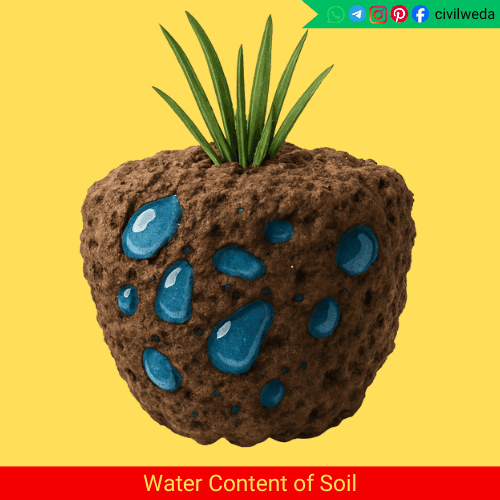
Water content is the ratio of the weight of water to the weight of soil solids in a given mass of soil, usually expressed as a percentage. It shows how much moisture is present in the soil. It is also called the moisture content of soil. There is no upper limit to water content. Water content is always greater than or equal to zero, but not less than zero.
Mathematically,
w≥0
Where,
= Weight of water
= Weight of dry soil
The moisture content of fine-grained soil is higher than that of coarse-grained soil.
2. Density of Soil
The density is the properties of soils which defined as mass per unit volume of soil. can be expressed in two forms: particle density and bulk density.
(a) Particle Density (ρs):
It represents the density of the soil solids only, excluding air and water.
For mineral soils, particle density generally ranges between 2.60 and 2.75 g/cm³, while for organic soils, it is lower, around 1.1 to 1.5 g/cm³, due to lighter organic matter.
(b) Bulk Density (ρ):
Bulk density is the mass of soil per unit total volume, including both solids and pore spaces. It depends on soil texture, structure, and porosity. Typically, coarse-grained soils have higher bulk density (1.6–2.0 g/cm³), whereas organic soils have much lower bulk density (0.8–1.2 g/cm³).
3. Specific Gravity (G)
Specific gravity of soil solids is the ratio of the unit weight of soil solids to the unit weight of water.
Where,
γs = Unit weight of soil solids.γw = Unit weight of soil water.
Depending on how the voids and moisture are considered during testing, the specific gravity of soil can be classified into three main types: True, Apparent, and Bulk Specific Gravity.
(a) True Specific Gravity
True specific gravity is the ratio of the weight of soil solids only (excluding all pores, voids, and absorbed water) to the weight of an equal volume of water. It represents the real density of the solid particles that make up the soil. This value is determined in the laboratory using a pycnometer or density bottle.
Typical range for mineral soils lies between 2.60 and 2.90. True specific gravity is used for accurate geotechnical calculations, such as determining void ratio, porosity, and degree of saturation.
In simple words, True specific gravity gives the most accurate measure of the density of actual soil solids.
(b) Apparent Specific Gravity
Apparent specific gravity includes the volume of the soil solids plus the air-filled pores within them. Since it accounts for some internal voids, its value is slightly lower than the true specific gravity. This type is often used when the soil sample is partially saturated or contains entrapped air.
The typical range of apparent specific gravity is 2.50 to 2.80. It provides a more realistic representation of soil in its natural condition.
In simple words, Apparent specific gravity considers the soil as it exists in the field, with tiny air spaces inside the particles.
(c) Bulk (or Mass) Specific Gravity
Bulk specific gravity is the ratio of the total weight of the soil (solids + water) to the weight of an equal volume of water. It represents the density of the whole soil mass, including the air and water in its pores. This type is commonly used in rock and aggregate testing rather than fine-grained soils. The bulk specific gravity usually ranges from 1.8 to 2.6, depending on the moisture content and compaction of the soil.
In simple terms, Bulk specific gravity shows how heavy the entire soil mass is — not just the solids inside it.
Specific Gravity of Some Soils is given in the table below:
| Soil Type | Specific Gravity (G) | Remarks |
|---|---|---|
| Sand & Gravel | 2.65 – 2.68 | Normal mineral composition (quartz-based) |
| Silt & Silty Sand | 2.66 – 2.70 | Slightly higher due to fine particles |
| Inorganic Clay | 2.70 – 2.80 | Due to clay minerals (kaolinite, illite) |
| Soil high in mica & iron | 2.75 – 2.85 | Heavier minerals increase G value |
| Organic Soil | 1.0 – 2.0 | Heavier minerals increase the G value |
3. Void Ratio (e)
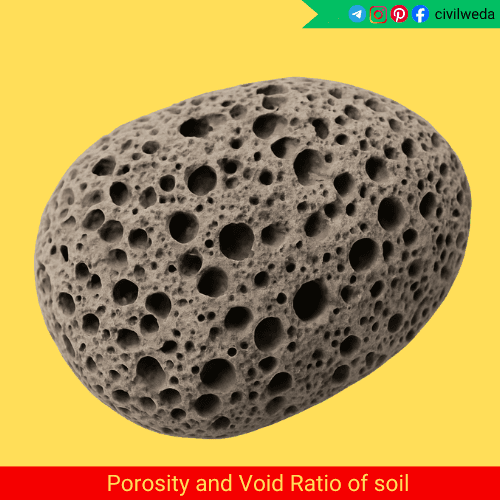
The void ratio (e) is one of the most fundamental properties of soil, used to describe its compactness or looseness. It represents the ratio of the volume of voids, which includes both air and water, to the volume of soil solids
Where:
- = Volume of voids (air + water)
- = Volume of solids
The void ratio indicates how much space exists between the soil particles. If the void ratio is high, it means the soil has more space and is loose. If it is low, the soil is dense and well-compacted.
In simple words:
A smaller void ratio = denser soil,
A larger void ratio = looser soil.
Porosity (n)
The porosity (n) of soil is also a very important properties of soil that is defined as the percentage of total volume that is occupied by voids (air and water). It is the ratio of the volume of voids and the total volume of soil mass. It shows how much of the soil volume is not filled with solid particles. Porosity is expressed either as a fraction or as a percentage.
Mathematically;
Where:
- = Volume of voids (air + water)
- = Total volume of soil (solids + voids)
Porosity tells us how “open” or “compact” a soil is. A high porosity means the soil has more void spaces, it can hold more water, but is less dense. A low porosity means fewer voids, the soil is compact and strong.
In simple words, Porosity shows how much of the soil volume is made up of space.
Note Point:
- Porosity is always greater than or equal to zero and not less than zero; n≥0
- For perfectly solid material (no voids), n=0
- For fully voided (imaginary) soil; n=100%
Relation Between Porosity and Void Ratio
The relation Between Porosity and Void Ratio is given by the following formula.
and
This relationship helps engineers easily convert one parameter into another.
4. Degree of Saturation (S)
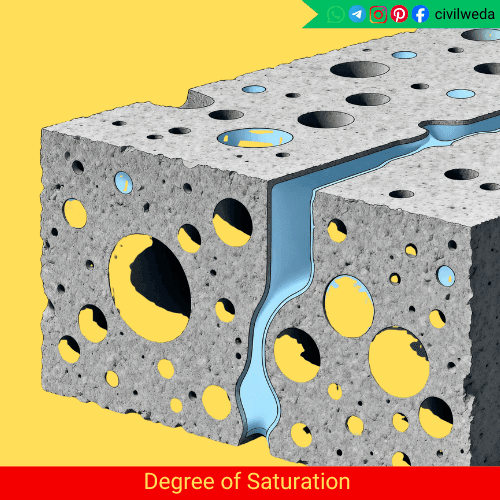
The degree of saturation (S) is the properties of soil that represents how much of the void space in a soil mass is filled with water. It is the ratio of the volume of water and the total volume of soil mass. It shows the wetness of soil, and is expressed either as a percentage or a decimal fraction.
The degree of saturation tells us how many of the voids are occupied by water. If the soil has both air and water in its pores, it is partially saturated. If all the voids are filled with water, it is fully saturated.
Mathematically;
Where;
- = Volume of water
- = Volume of voids (air + water)
- S = Degree of saturation
Note Points:
- The degree of saturation helps determine the moisture condition of soil (dry, moist, or saturated).
- The degree of saturation is used in calculating effective stress and pore water pressure.
- It is Important for consolidation and seepage analysis.
- It indicates the suitability of the soil for compaction and foundation work.
Read more Civil Engg Topics
- Viscosity
- Portland Cement
- Instruments used in a chain survey
- Bulking of sand
- Pile Foundation
- Ready Mixed Concrete
- Capillary action
- Surface energy
- Timber
- Seasoning of Timber
- Chlorination of water
Conclusion
Understanding the properties of soil is the foundation of soil mechanics and an essential part of every civil engineering project.
Each of these properties of soil, such as water content, density, void ratio, porosity, degree of saturation, or specific gravity, helps engineers determine how soil will behave under different environmental and loading conditions.
By studying these properties of soil, civil engineers can evaluate the strength, stability, and suitability of soil for construction works such as foundations, embankments, roads, and retaining structures.
In simple terms, A good understanding of soil properties ensures safe design, economical construction, and long-lasting structures.
So before starting any construction project, proper soil testing and analysis should always be carried out. Remember, strong structures begin with strong soil knowledge.
1. What is the difference between porosity and void ratio?
Both represent the amount of void space in soil, but-
Porosity (n) = percentage of total volume that is voids, Void Ratio (e) = ratio of void volume to solid volume.
2. What is the unit weight of water used in soil mechanics?
The unit weight of water () is 9.81 kN/m³ or 1 g/cm³.
3. Which properties of soil affect permeability the most?
Porosity and grain size have the greatest influence on permeability. Coarse-grained soils are more permeable than fine-grained soils.
Thank You for Reading! 🙏
We hope this article helped you clearly understand the properties of soil in civil engineering. If you found this complete article useful, please share it with your friends and university students. For more informative posts on civil engineering topics, stay connected with Civil Weda. 🚀