
Introduction
In civil engineering, understanding how soil behaves under different conditions is very important. The strength and stability of any structure depend largely on the nature of the soil beneath it. When a soil mass, especially clay, is disturbed by excavation, vibration, or remoulding, its strength often decreases.
This change in soil strength due to disturbance is expressed by a property known as the sensitivity of soil. It tells us how much the soil’s original (undisturbed) strength is reduced when it is remoulded. In simple words, a highly sensitive soil can lose most of its strength when disturbed, while a less sensitive soil retains most of its strength.
Engineers study soil sensitivity to ensure that foundations, slopes, and earth structures remain safe even after the soil is disturbed during construction.
In this article, we will discuss the definition and formula of the sensitivity of soil in a simple and clear way so that students can easily understand its importance in soil mechanics. So let’s get started without any further delay.
The sensitivity of soil is a measure of how much the strength of a soil decreases when it is remoulded or disturbed. In other words, it shows how sensitive a soil is to mechanical disturbance such as digging, loading, or vibration.
According to Terzaghi and Peck (1948):
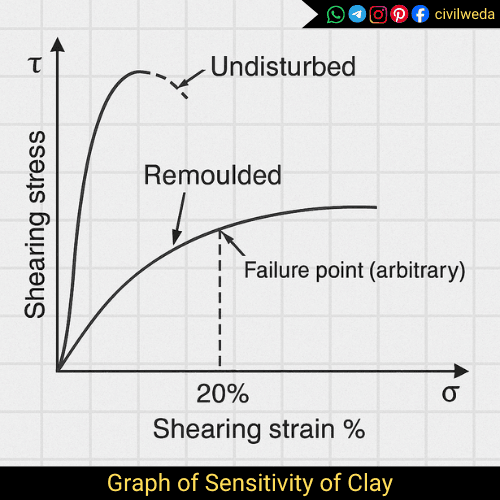
“The sensitivity of soil is the ratio of the undisturbed shear strength to the remoulded shear strength of the same soil at the same water content.”
In simple terms, sensitivity tells us how much weaker the soil becomes after being disturbed.
For example, if a clay sample loses half of its strength when remoulded, it means the soil has a moderate sensitivity.
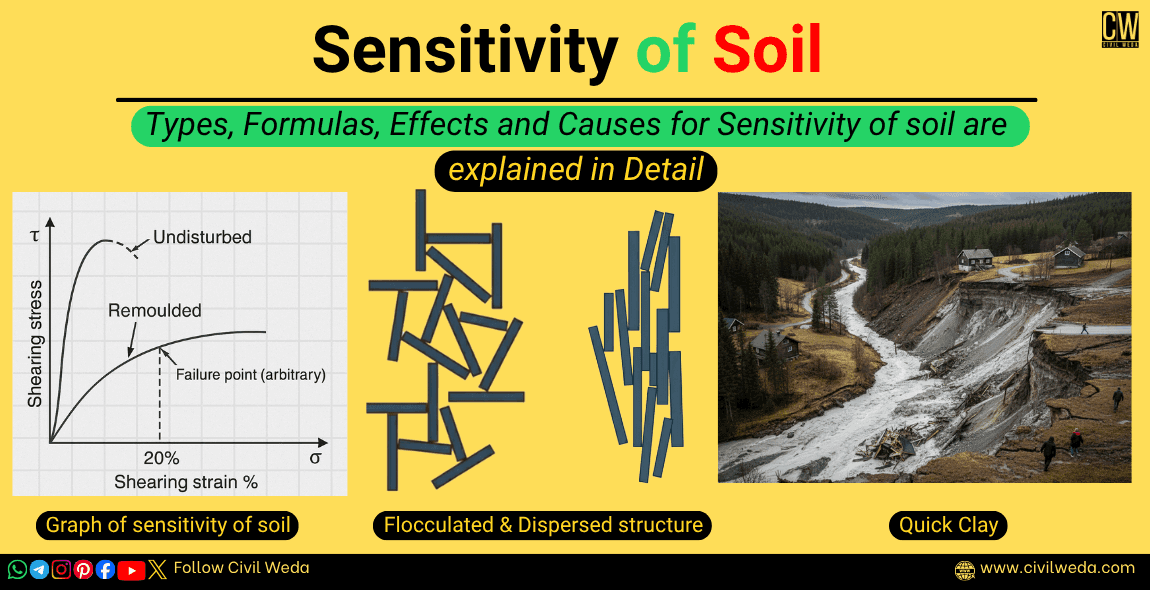
Highly sensitive soils, especially marine clays or quick clays, can lose almost all of their strength after disturbance, turning from a firm solid to a soft or even liquid-like state. The graph of sensitivity is shown in the figure.
Formula for the Sensitivity of Soil
The sensitivity of soil (S) is expressed as the ratio of its undisturbed shear strength to its remoulded shear strength at the same water content.
Where,
- S = Sensitivity of soil (no unit)
- Undisturbed shear strength = Shear strength of soil in its natural condition.
- Remoulded shear strength = Shear strength of the same soil after being disturbed or remoulded
Note points:
- Sensitivity is a dimensionless quantity, because both strengths are measured in the same unit (e.g., kN/m²).
- The higher the value of sensitivity, the greater the loss of strength after disturbance of the soil mass.
For example:
If the undisturbed shear strength of a clay sample is 80 kN/m² and its remoulded strength is 20 kN/m², then:
This means the soil is highly sensitive, as it loses 75% of its original strength when remoulded.
Classification of Soil Based on the Sensitivity of Soil
The sensitivity of soil helps engineers understand how much strength a soil loses after it is disturbed or remoulded. Based on the ratio of undisturbed shear strength to remoulded shear strength, soils are grouped into different categories. This classification is commonly used in soil mechanics and geotechnical engineering.
Classification of Soil Based on the Sensitivity of Soil is given in the table below:
| Sensitivity of soil (S) | Type of Soil | Description |
| 1 – 2 | Slightly Sensitive | Soil shows very little loss in strength after remoulding. Common in stiff clays and silts. |
| 2 – 4 | Moderately Sensitive | Strength reduces noticeably, but the soil still retains stability. |
| 4 – 8 | Highly Sensitive | Considerable loss of strength occurs when disturbed. Found in soft to medium clays. |
| 8 – 16 | Extra Sensitive | Soil structure breaks down easily; it becomes very weak after remoulding. |
| > 16 | Quick Clay | Extremely sensitive soil that can lose almost all its strength and behave like a liquid when disturbed. |
Note Points:
- Soils with low sensitivity (S = 1–2) behave almost the same before and after remoulding.
- As sensitivity increases, the loss of shear strength becomes more significant.
- Soils with S > 16, known as quick clays, are the most dangerous because they may collapse or flow suddenly when disturbed — a serious concern in foundation and slope design.
Causes for the Sensitivity of Soil
The sensitivity of soil mainly depends on its structure, water content, and bonding between soil particles.
When the soil structure is disturbed, the arrangement of particles changes, resulting in a significant loss of shear strength. Several factors are responsible for this behaviour.
1. High Water Content
When the soil has a high water content, the water pressure between particles increases. This reduces the contact between solid particles and weakens the soil structure, making it more sensitive to disturbance.
2. Weak Particle Bonding
In clays, particles are bonded together by electrochemical and cementing forces. If these bonds are weak, the soil easily loses its strength when remoulded.
3. Flocculated Structure
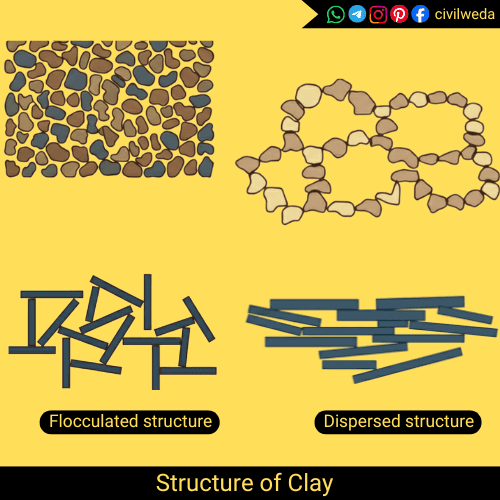
Fine-grained soils like clays often have a flocculated structure (particles arranged edge-to-face). When disturbed, this structure becomes dispersed (particles arranged face-to-face), causing a large reduction in strength. The Flocculated Structure of clay is shown in the figure.
4. High Pore Water Pressure
Soils with high pore water pressure are less stable. Any small disturbance can cause a sudden collapse of the soil structure due to the release of trapped water.
5. Lack of Cementation
If the soil particles are not well-cemented or bonded by natural minerals, they easily lose their interparticle strength when remoulded.
6. Mechanical Disturbances
Excavation, loading, vibration, or even sampling can disturb the natural structure of soil. Such mechanical actions often trigger the loss of strength in sensitive soils.
Engineering Importance / Effects of Soil Sensitivity
The sensitivity of soil is a crucial factor in geotechnical engineering because it directly affects the stability and safety of structures built on or within the ground. A soil that loses a large portion of its strength after being disturbed can cause serious problems during and after construction.
Here are some major engineering effects and practical reasons why soil sensitivity must be studied.
1. Foundation Design
The bearing capacity of soil decreases as sensitivity increases. If the foundation is placed on highly sensitive soil, it may settle unevenly or even fail after construction due to the loss of strength. Hence, engineers must consider soil sensitivity while determining the safe bearing capacity of the site.
2. Slope Stability
In slopes or embankments, sensitive clays can lose strength suddenly when disturbed by rainfall, loading, or excavation. This sudden reduction can lead to landslides or slope failures, especially in quick clay deposits.
3. Excavation and Earthworks
During excavation or tunnelling, the soil structure gets disturbed. Highly sensitive soils can collapse unexpectedly, making excavation work risky. Proper slope protection or dewatering is needed in such areas.
4. Sampling and Testing
When collecting soil samples for testing, remoulding should be avoided as it affects the actual strength. Engineers use undisturbed samples to obtain accurate shear strength values of sensitive soils.
5. Vibration and Construction Activities
Activities such as piling, machinery vibration, or traffic load can disturb sensitive soil layers. Continuous vibration may cause the soil to lose stability and increase settlement beneath structures.
6. Quick Clay Failures

In some regions, such as Norway and Canada, quick clays (S > 16) have caused large-scale ground collapses. These soils behave like a solid when intact but flow like a liquid when disturbed, leading to devastating landslides.
Thus, the study of the sensitivity of soil helps engineers predict strength loss and design safer foundations, slopes, and earthworks. Ignoring the sensitivity of soil can lead to failure of structures even if the initial soil strength seems sufficient.
Read more Civil Engg Topics
- Viscosity
- Portland Cement
- Instruments used in a chain survey
- Bulking of sand
- Bitumen concrete
- Pile Foundation
- Surface tension
- Ready Mixed Concrete
- Capillary action
- Timber
- Chlorination of water
- Atterberg Limits
- Basic Properties of Soil
Conclusion
The sensitivity of soil is one of the most important properties that describes how soil strength changes when it is disturbed. It tells us how much weaker a soil becomes after remoulding and helps engineers predict the possible loss of stability in the field.
Soils with low sensitivity retain most of their strength even after disturbance, whereas highly sensitive or quick clays can lose almost all of their strength and behave like a liquid.
Understanding the sensitivity of soil is therefore essential in foundation design, slope stability, and excavation works. It ensures that the structures built on such soils remain safe, stable, and long-lasting, even when the ground beneath them is disturbed.
1. What is the sensitivity of soil?
The sensitivity of soil is the ratio of its undisturbed shear strength to its remoulded shear strength at the same water content.
2. What are the units of sensitivity of soil?
Sensitivity is a dimensionless ratio, so it has no unit.
3. What factors affect the sensitivity of soil?
The main factors are water content, soil structure, bonding between particles, pore water pressure, and mechanical disturbance.
4. Why is the sensitivity of soil important in engineering?
Because it helps engineers predict the loss of soil strength after disturbance. This is essential in designing foundations, slopes, and excavations to prevent failure or collapse.
Thank You for Reading! 🙏
We hope this article helped you clearly understand the Portland Cement in civil engineering. If you found this complete article useful, please share it with your friends and university students. For more informative posts on civil engineering topics, stay connected with Civil Weda. 🚀