
1. Introduction
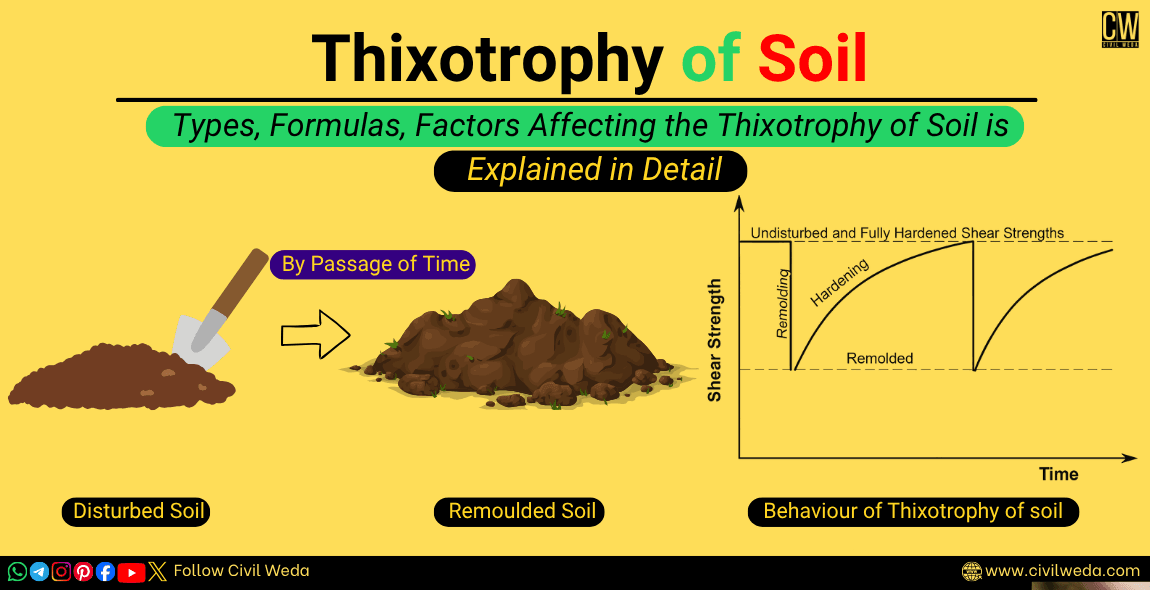
In soil mechanics, many natural phenomena affect how soil behaves under load or after disturbance. One such fascinating property is thixotropy, a time-dependent change in soil strength without any alteration in moisture content.
This concept plays a crucial role in geotechnical engineering, particularly when dealing with fine-grained soils like clays. Understanding thixotropy helps engineers predict soil behaviour during excavation, foundation settlement, or earthwork construction.
In this article, we will learn everything about the thixotropy of soil, from its definition and mechanism to its engineering importance and real-life examples. So, let’s get started without any further delay!
2. What is the Thixotropy of Soil
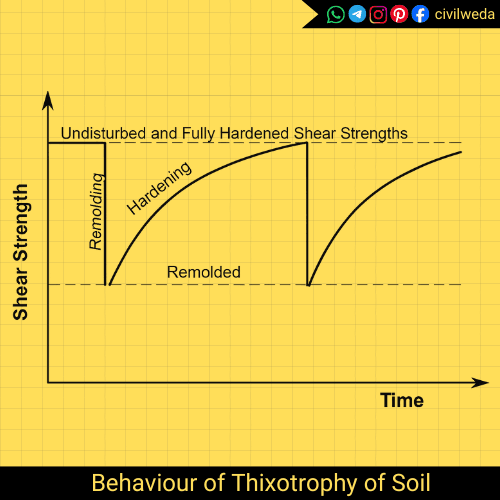
Thixotropy can be defined as the property of certain soils to regain a part of their lost strength with time, after remoulding, without any change in water content or volume.
When a clay soil is disturbed (for example, during excavation or pile driving), its structure is broken, and the soil loses much of its strength. However, if left undisturbed for some time, the particles slowly reorient and rebuild a structure, resulting in a partial recovery of strength.
In simple words:
- Disturbance → Loss of strength
- Rest period (no water change) → Strength recovery
This reversible, time-dependent process is called thixotropy of soil.
Thixotropy Index (TI)
The Thixotropy Index (TI) is sometimes defined as the ratio of recovered strength to the remoulded strength.
- Cu recovered = Undrained shear strength after rest period.
- Cu remoulded = Undrained shear strength immediately after remoulding.
A higher TI indicates a greater thixotropic behaviour.
3. Mechanism of Thixotropy of Soil
The mechanism of thixotropy mainly depends on the rearrangement of soil particles at the microstructural level.
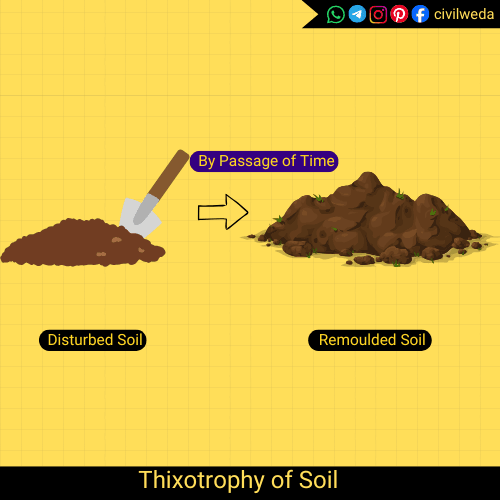
When clay soils are in their natural state, particles are arranged in a flocculated structure, meaning the particles are loosely bonded edge-to-face due to electrochemical attraction. This structure provides significant shear strength.
When the soil is remoulded or disturbed, this flocculated arrangement breaks down into a dispersed structure, where the particles are more aligned and separated. As a result, the soil loses cohesion and becomes weak.
After the disturbance, if the soil is allowed to remain undisturbed, the particles slowly re-flocculate due to natural attractive forces, gradually restoring part of the lost strength. This time-dependent reformation of the structure is what we call thixotropic hardening.
In essence, thixotropy arises from:
- Breakdown of interparticle bonds during remoulding, and
- Gradual rebuilding of those bonds during rest.
A simple infographic diagram is shown in the figure:
4. Types of Soils Exhibiting Thixotropy
Thixotropy is mostly observed in fine-grained soils, particularly clays and silts. However, not all clays exhibit the same level of thixotropy.
(a) Highly Thixotropic Soils:
- Montmorillonite and illite clays show strong thixotropic behaviour due to their high surface area and electrochemical activity.
- Marine clays are also highly thixotropic and sensitive.
(b) Moderately Thixotropic Soils:
- Kaolinite shows mild thixotropy because it has a lower specific surface area and less ion exchange capability.
(c) Non-Thixotropic Soils:
- Coarse-grained soils (like sands and gravels) show almost no thixotropy since their structure is governed by particle contact rather than electrochemical bonding.
5. Factors Affecting the Thixotropy of Soil
The degree of thixotropy in a soil mass depends on several factors:
(a) Soil Type and Mineralogy
Clay minerals with high specific surface area and charged surfaces exhibit more thixotropy. Montmorillonite > Illite > Kaolinite in order of thixotropic tendency.
(b) Water Content
Optimum water content promotes particle mobility and rearrangement. If the soil is too dry or too saturated, thixotropy reduces significantly.
(c) Degree of remoulding
More intense remoulding breaks more interparticle bonds, increasing the potential for strength recovery later.
(d) Time of Rest
The longer the rest period after remoulding, the more the particles can re-flocculate, and hence the greater the strength recovery.
(e) Temperature
Higher temperatures may accelerate particle movement and enhance the rate of thixotropic hardening.
(f) Presence of Electrolytes
Salts and ions in pore water can influence interparticle attraction, affecting both the rate and magnitude of thixotropy.
6. Laboratory Observation of Thixotropy of Soil
Thixotropy can be observed experimentally through shear strength tests on remoulded and aged soil samples.
Common Procedure:
- Measure the undisturbed shear strength of the soil sample.
- Remould the sample completely to destroy its structure.
- Measure the immediate shear strength after remoulding.
- Leave the remoulded sample undisturbed for a period (e.g., 1 day, 7 days, etc.).
- Measure the recovered shear strength after resting.
The ratio of recovered strength to remoulded strength gives an indication of thixotropy.
Testing Methods:
- Vane shear test (commonly used for clays)
- Unconfined compression test
- Triaxial shear test
These experiments clearly show that soil regains part of its lost strength with time, even though there’s no change in moisture or density.
7. Engineering Significance of the Thixotropy of Soil
Thixotropy has great practical importance in geotechnical engineering, as it influences how soil behaves during and after construction.
(a) Excavation and Earthwork
When excavating soft clay, the soil may lose strength temporarily but can regain it later due to thixotropy. This recovery is beneficial for long-term stability.
(b) Foundation Engineering
During pile driving or foundation installation, soil around the pile gets remoulded and loses strength. However, with time, the surrounding soil gains strength again, contributing to the setup effect or pile ageing.
(c) Embankments and Dams
Thixotropy helps in stabilising embankments over time. Initially, there may be a settlement, but later, soil strength improves naturally.
(d) Stability of Natural Slopes
In sensitive clays, thixotropy may aid in recovery after small slips, preventing progressive failures.
Thus, understanding thixotropy helps engineers design safer and more reliable earth structures.
Read more Civil Engg Topics
- Timber
- Chlorination of water
- Seasoning of Timber
- Difference between Tar and Bitumen
- Types of soil
- Atterberg Limits
- Compass Survey
- Factors affecting per capita demand
- Drip Irrigation
8. Conclusion
Thixotropy is a time-dependent property that allows certain soils, especially clays, to regain strength after being disturbed. It occurs due to the gradual reformation of interparticle bonds without any change in water content or volume.
This property is vital in geotechnical engineering, affecting pile foundations, excavations, embankments, and even natural slope stability. Engineers must understand and account for thixotropic behaviour when designing structures on fine-grained soils.
So, thixotropy reminds us that soils are not static materials — they change, heal, and strengthen over time under natural forces.
9. FAQs on Thixotropy of Soil
1. What is thixotropy in simple terms?
It’s the property of soil to regain its lost strength over time after being disturbed, without any change in water content.
3. How does thixotropy differ from sensitivity?
Sensitivity measures loss of strength due to remoulding, while thixotropy measures the recovery of that strength over time.
4. How can we test thixotropy in the lab?
Through vane shear or unconfined compression tests, comparing the immediate and aged strength after remoulding.
Thank You for Reading! 🙏
We hope this article helped you clearly understand the thixotropy of soil in civil engineering. If you found this complete article useful, please share it with your friends and university students. For more informative posts on civil engineering topics, stay connected with Civil Weda 🚀