
Introduction
Every structure we see around us, from small houses to massive bridges, stands firmly on the soil beneath. In civil engineering, soil is not just a natural material; it is the foundation of every construction project. Understanding the type of soil is the first and most important step before designing any structure, because the strength and stability of a building directly depend on the soil it rests upon.
Different soils behave differently under load. Some offer high strength and excellent drainage, while others may shrink, swell, or settle when wet. Therefore, knowing the types, properties, and behaviour of soil helps engineers make safe and economical construction decisions.
In this article, we will explore the various type of soil, their classification, their engineering properties and uses in civil Engineering. Let’s get started…
What is Soil?
Soil is the natural layer of loose material that covers the surface of the Earth. It is formed by the weathering of rocks over thousands of years due to physical, chemical, and biological processes. In simple words, soil is a mixture of minerals, organic matter, water, and air that supports both plant life and construction works.
For civil engineers, soil is not just ordinary ground. It serves as the foundation for every structure, whether it’s a small house, a highway, or a massive structure like a bridge. The type of soil and quality of soil at a construction site directly influence the strength, safety, and stability of the structure built upon it.
Different type of soil has different characteristics. For example, gravel and sand provide good drainage and strength, while clay and silt can hold water and may shrink or expand with moisture changes. That’s why understanding soil behaviour is the first step in every engineering design and construction project.
Type of Soil
In civil engineering, soil is classified in different ways to understand its behaviour and suitability for construction. The most common classifications are based on particle size, origin, and engineering behaviour. Each and every type of soil shows different physical properties, drainage characteristics, and load-bearing capacities.
Based on Particle Size
This is the most common and basic method of soil classification. Soils are divided according to the size of their particles.
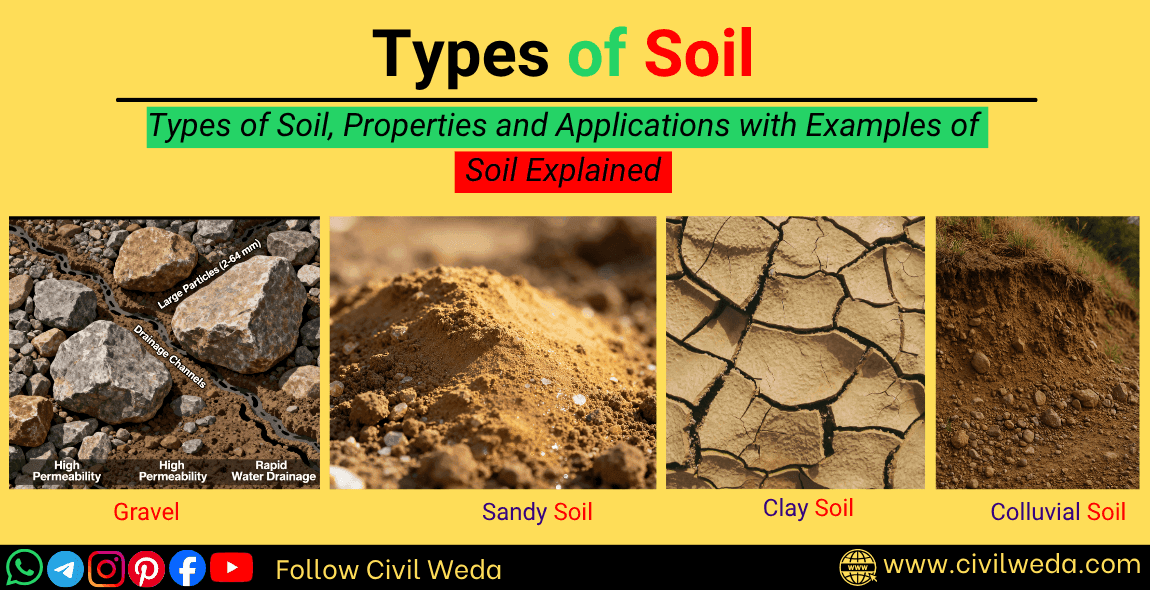
1. Gravel
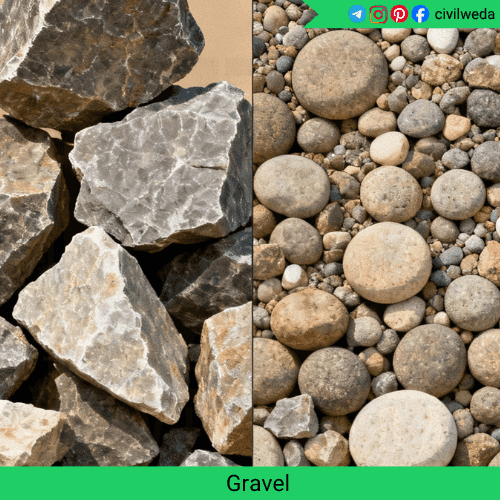
Gravel is a type of soil that has the largest particles, usually more than 2 mm in diameter. It provides excellent drainage and high strength, making it ideal for road sub-base and foundation layers. Structures built on gravelly soil are generally more stable due to its good load-bearing capacity.
2. Sand
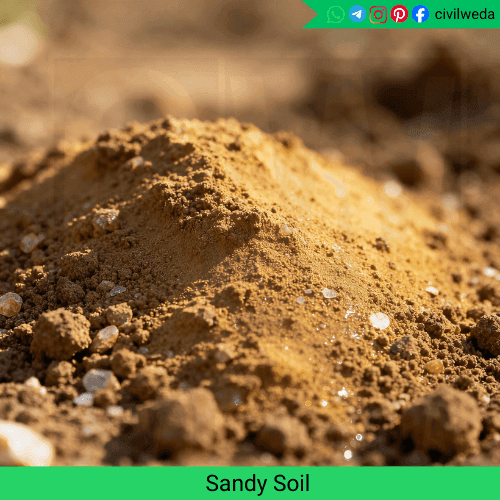
Sand is a type of soil that has particles ranging between 0.075 mm and 2 mm in diameter. Sand allows water to drain easily and provides moderate strength. It is commonly used in construction materials like mortar, concrete, and backfill. Although it doesn’t retain water well, it is easy to compact and provides good support for lightweight structures.
3. Silt
Silt is a type of soil that has fine, smooth particles ranging from 0.002 mm to 0.075 mm. It holds water better than sand but drains slowly. Because of its moderate strength and tendency to erode easily, silt is not preferred for heavy structures. However, it can be used in embankments and landscaping.
4. Clay
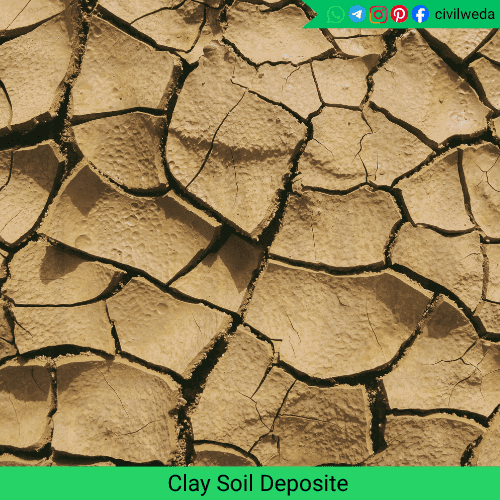
Clay is a type of soil that contains the finest particles, smaller than 0.002 mm. It is highly cohesive and retains water, which makes it sticky when wet and hard when dry. Due to its poor drainage and high compressibility, clay is not suitable for heavy foundations, but it is used for making bricks, earthen structures, and impermeable layers in canals or dams.
Summary:
| Type of Soil | Particle Size Range (mm) | Characteristics | Engineering Use |
| Gravel | > 2.0 mm | Large particles, excellent drainage, high strength | Road sub-base, foundation layer |
| Sand | 0.075 – 2.0 mm | Coarse texture, good drainage, easy to compact | Concrete, mortar, and backfilling |
| Silt | 0.002 – 0.075 mm | Fine particles, smooth texture, moderate drainage | Embankments, landscaping |
| Clay | < 0.002 mm | Very fine, sticky when wet, poor drainage, high plasticity | Brick making, earthen structures |
Transported Soils
When soil is carried away from its place of origin and deposited elsewhere by natural agents such as water, wind, ice, or gravity, this type of soil is called as Transported Soil. This type of soil has different properties depending on how they were moved and where it was deposited. Let’s understand each type in detail…
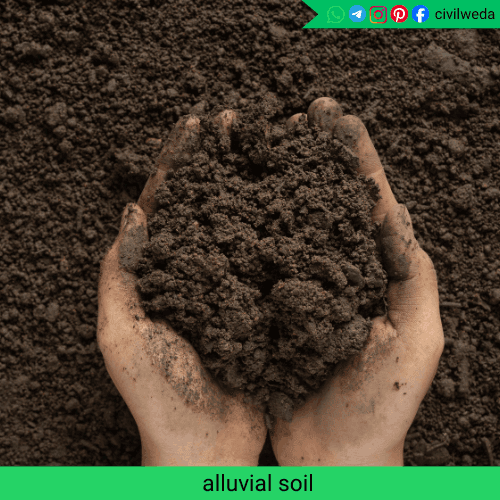
1. Alluvial Soil
Alluvial soils are a type of soil that is transported and deposited by running water, such as rivers and streams. When rivers flow down from mountains, they carry fine particles like sand, silt, and clay. As the flow slows down in plains, these materials settle down and form layers of alluvial soil.
This type of soil is found mostly in river valleys, flood plains, and deltas. It is usually fertile, soft, and easy to work with, which makes it excellent for agriculture. In civil engineering, alluvial soil has moderate strength and high compressibility, so it requires proper soil testing before constructing heavy structures. However, it is ideal for light structures, embankments, and irrigation channels.
2. Aeolian Soil
Aeolian soil is a type of soil that is formed by the action of wind. The wind carries fine sand and dust particles from one place and deposits them in another, usually in dry and desert regions. Over time, these particles accumulate to form sand dunes or sandy plains.
This type of soil is common in deserts and coastal areas, where strong winds constantly move fine particles. Aeolian soil is loose, dry, and cohesionless, which means it does not stick together and can easily shift with wind pressure. Because of its low bearing capacity, it is not suitable for heavy structures but can be used for temporary constructions, pavements, or landscaping after stabilisation.
3. Glacial Soil
Glacial soil is type of soil that is transported by moving glaciers. During the ice age or in cold mountainous regions, glaciers carry rocks, sand, and clay as they move slowly downhill. When the ice melts, it leaves behind a mixture of materials known as glacial deposits or till.
This type of soil is found in hilly and polar regions and is usually dense, coarse, and well-drained. Because they contain a mix of particles ranging from fine clay to large boulders, their properties vary greatly. In engineering works, glacial soils are used for road subgrades and embankments where good drainage is required.
4. Colluvial Soil
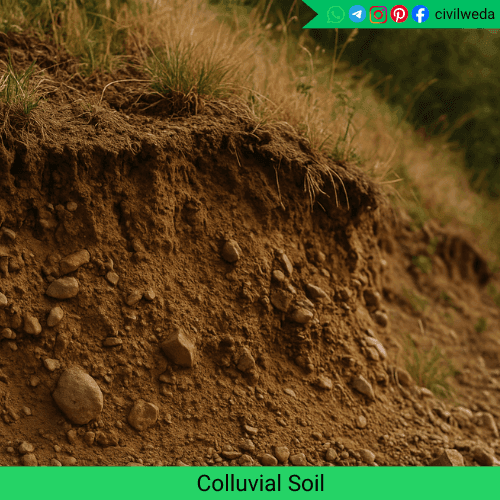
Colluvial soil is a type of soil that is formed by the downward movement of soil and rock materials due to gravity. This process happens mostly on steep slopes or hilly areas, where loosened materials slide or roll down the slope and accumulate at the bottom.
This type of soil is coarse, irregular, and poorly sorted, meaning it contains a mix of different particle sizes — from fine silt to gravel and stones. Colluvial soils are found at the base of hills or mountain slopes, and their stability largely depends on the slope angle and moisture conditions. Engineers must study their compaction and drainage characteristics carefully before construction.
Summary:
| Type of Soil | Transporting Agent | Common Locations | Key Characteristics | Engineering Notes |
| Alluvial Soil | Water (rivers, streams) | River valleys, flood plains | Fine texture, fertile, compressible | Requires soil testing before heavy construction |
| Aeolian Soil | Wind | Deserts, coastal regions | Loose, dry, cohesionless | Needs stabilisation before use |
| Glacial Soil | Ice (glaciers) | Cold mountainous regions | Mixed texture, dense, well-drained | Good for roads and embankments |
| Colluvial Soil | Gravity | Base of hills/slopes | Coarse, irregular, poorly sorted | A stability check is needed before construction |
Based on Engineering Behaviour
From an engineering point of view, soils are classified according to how they behave under load and moisture conditions. This classification helps civil engineers determine the stability, strength, and suitability of the soil for different types of construction.
Broadly based on Engineering Behaviour, soils are divided into two main categories — Cohesive soils and Cohesionless soils.
1. Cohesive Soil
Cohesive soils are a type of soil that sticks together due to the presence of very fine particles like clay and silt. The force that binds these particles is called cohesion. These soils contain a considerable amount of moisture, which makes them plastic and moldable when wet but hard and stiff when dry.
Cohesive soils have low permeability, meaning they do not allow water to pass through easily. Because of this, they are prone to shrinkage and swelling with changes in moisture content. Clay, for example, expands when wet and contracts when dry, which can cause cracks or settlement in structures if not treated properly.
From a construction point of view, cohesive soils need special attention during foundation design. Engineers often use techniques like soil stabilisation, compaction, or providing proper drainage layers to improve their strength and reduce settlement.
Examples: Clayey soil and silty soil.
2. Cohesionless Soil
Cohesionless soils are a type of soil that consists of larger particles, such as sand and gravel, that do not stick together. There is no cohesive force between the particles; instead, their strength depends on friction between them. These soils are free-draining, which means they allow water to pass through easily and do not retain moisture.
Cohesionless soils are easy to compact and provide excellent support for structures, making them ideal for foundations, pavements, and retaining walls. Because of their good drainage, they prevent waterlogging and help maintain stability even during heavy rains. However, since these soils lack cohesion, they can easily get displaced under vibration or when dry, so proper compaction is necessary during construction.
Examples: Sandy soil and gravelly soil.
Cohesive and cohesionless soils behave very differently during construction. While cohesive soils require careful design and stabilisation, cohesionless soils offer natural strength and drainage, making them highly suitable for most foundation works.
Summary:
| Type of Soil | Examples | Nature | Drainage | Engineering Characteristics |
| Cohesive Soil | Clay, Silt | Fine-grained, sticky | Poor | Plastic, low strength when wet, shrink-swell behaviour |
| Cohesionless Soil | Sand, Gravel | Coarse-grained, loose | Good | High strength, easy to compact, stable under load |
Importance of Soil Study in Civil Engineering
In any construction project, soil is the foundation of everything. No matter how strong the structure is, it will not remain stable if the soil beneath it is weak. That’s why studying and understanding soil is one of the most important steps in civil engineering.
Before starting any construction, engineers conduct a soil investigation to find out the type, strength, and bearing capacity of the soil at the site. This helps in deciding the type of foundation, the depth of excavation, and even the materials required for construction. For example, sandy or gravelly soils can support heavy loads easily, while clayey soils need special treatment like stabilisation or deep foundations.
The study of soil also helps engineers to prevent failures such as cracks, settlements, and landslides. It ensures that structures remain safe, durable, and economical throughout their lifespan. Apart from buildings, soil study is equally important for the design of roads, embankments, dams, and retaining walls, where the stability of the structure depends directly on the soil below.
In simple words, strong structures come from strong soil knowledge. A civil engineer who understands soil behaviour can design foundations that not only support the load effectively but also resist environmental challenges like rainfall, groundwater, and temperature changes.
Read more Civil Engg Topics
- Viscosity
- Portland Cement
- Bulking of sand
- Bitumen concrete
- Geopolymer Concrete
- Pile Foundation
- Surface tension
- Vapour Pressure
- Capillary action
- Surface energy
- Timber
- Chlorination of water
Conclusion
Soil is the true foundation of every structure. Whether it’s a small residential building, a massive bridge, or a dam, the strength and durability of any construction depend on the type of soil it rests upon. Each soil type—gravel, sand, silt, or clay—has unique properties that influence the performance of the structure built over it.
A proper understanding of soil classification, properties, and behaviour allows civil engineers to design foundations that are both safe and economical. Studying the nature of soil also helps in preventing problems such as cracks, settlements, and structural failures in the future.
In short, good soil knowledge leads to good construction.
A successful civil engineer is not the one who just builds on soil but the one who truly understands what lies beneath it.
FAQs
1. What is the main type of soil in civil engineering?
The main type of soil in civil engineering are gravel, sand, silt, and clay, classified based on particle size.
2. What is cohesive soil?
Cohesive soil has fine particles like clay and silt that stick together and retain water.
3. What is cohesionless soil?
Cohesionless soil, such as sand or gravel, has coarse particles that don’t stick together but provide good strength.
4. What type of soil has the best drainage property?
Gravel provides the best drainage due to its large particle size.
5. What is the particle size of clay soil?
Clay particles are smaller than 0.002 mm in diameter.
Thank You for Reading! 🙏
We hope this article helped you clearly understand the Type of Soil in Civil Engineering in civil engineering. If you found this complete article useful, please share it with your friends and university students. For more informative posts on civil engineering topics, stay connected with Civil Weda. 🚀