
Introduction
In fluid mechanics, understanding how a fluid behaves when it moves at high speeds or interacts with another surface is very important. Sometimes a water jet remains smooth, while other times it breaks into tiny droplets. In some situations, raindrops stay in a round shape, and in others, they fall apart and splash everywhere. Why does this happen? The answer lies in a dimensionless quantity called the Weber Number.
The Weber Number helps engineers compare the force that tries to break a fluid surface with the force that keeps it together. It explains whether a droplet will stay stable or break into smaller droplets when it moves through air or water. From hydraulic structures to spray nozzles, from wave impact to soil erosion, Weber Number plays a key role in predicting fluid behaviour.
In this article, we will understand the Weber Number, its definition and formula, with applications in a simple and easy to understand language. So let’s get started.
Definition of Weber Number
As per Wikipedia, the Weber Number (We) is a dimensionless quantity that compares two important forces acting on a fluid surface:
- Inertial force: Inertial force is the force that comes from the motion or speed of the fluid
- Surface tension force: Surface tension force is the force that tries to keep the fluid surface stable and unbroken
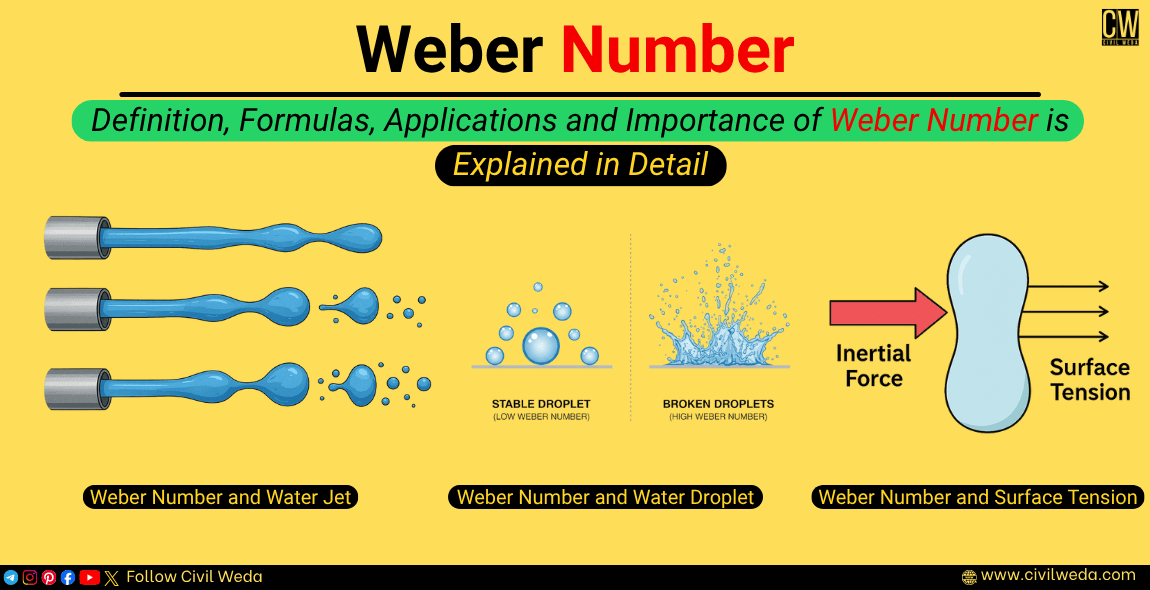
In simple words, we can say that Weber No is the ratio of the inertial force to the Surface tension force. And it tells us whether a moving droplet, jet, or fluid surface will remain stable or will break apart.
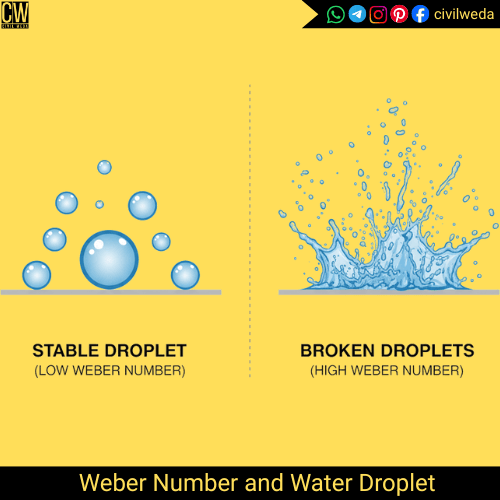
- If the inertial force is stronger, the droplet tends to break.
- If the surface tension is stronger, the droplet tends to remain stable. As shown in the above figure:
Because of this balance, the Weber Number is very useful for predicting splashing, droplet formation, breakup of water jets, and many other fluid behaviours that we see in nature and engineering.
I have also explained the Reynolds Number and Froude Number in detail. If you’re interested, you can click here to read it…
Formula of the Weber Number
The Weber Number is calculated using the following formula:
Where:
- ρ = Density of fluid (kg/m³)
- V = Velocity of fluid (m/s)
- L = Characteristic length (generally droplet or jet diameter)
- σ = Surface tension of fluid (N/m)
Simple Explanation
The formula shows that Weber No increases when:
- fluid velocity increases,
- fluid density increases, or
- droplet/jet size increases.
And it decreases when the surface tension of the fluid is high.
In short:
- Higher We → More breakup
- Lower We → More stability
Physical Meaning of Weber Number
The Weber Number tells us how a fluid surface will behave when it is moving. It shows the competition between two forces: the Inertial force and the Surface tension force. When surface tension is stronger, the droplet or water jet stays in shape and remains stable, and when inertial force becomes stronger, the droplet begins to stretch and finally breaks into smaller droplets.
- High Weber No (We > 1) → Inertial force dominate → Droplet breakup, splashing
- Low Weber No (We < 1) → Surface tension dominate → Droplet stable
Weber Number Ranges and Flow Behaviour
1. Low Weber No (We < 1)
Surface tension is the dominant force. Droplets remain stable, maintain their shape, and resist deformation.
2. Moderate Weber No (We = 1 – 10)
Inertial force and surface tension are comparable. Droplets may deform slightly, but they usually remain intact.
3. High Weber No (We > 10)
Inertial forces dominate. Droplets begin to stretch, oscillate, and eventually break into smaller droplets. Splashing and jet breakup are common in this range.
A typical range of the Weber number and flow behaviour is given in the table below:
| Weber Number Range | Dominant Force | Flow / Droplet Behaviour |
| We < 1 | Surface tension dominates | Droplets remain stable and resist deformation. |
| We = 1 – 10 | Balanced forces | Droplets deform slightly but generally stay intact. |
| We > 10 | Inertial forces dominate | Droplets stretch, vibrate, and eventually break apart; splashing occurs. |
Importance of Weber Number
The Weber Number is extremely important in fluid mechanics because it helps engineers and researchers understand how a fluid surface will behave under different conditions. It predicts whether a droplet will stay stable or break into smaller parts, making it a key parameter in many practical applications.
- Predicts droplet breakup
It tells whether a moving droplet will remain intact or disintegrate due to high-speed motion. - Helps in analysing jet stability
Water jets from pipes, nozzles, or spillways remain smooth or break depending on their Weber Number. - Important for spray formation
In systems like spray nozzles, fuel injectors, agricultural sprayers, and cooling systems, Weber No determines droplet size and spray quality. - Useful in wave and impact studies
In coastal engineering, Weber No helps understand how waves break and how the water surface responds to strong forces. - Guides hydraulic structure design
It helps predict splashing, air entrainment, and water breakup in spillways, stilling basins, and high-velocity flows. - Supports research in boiling and bubble formation
It is also used in understanding heat transfer processes, where bubbles form and detach from hot surfaces.
Applications of the Weber Number
The Weber No is widely used to understand and predict how fluid surfaces behave in different engineering and natural situations. Because it compares inertial force and surface tension, it becomes a powerful tool in analysing droplet formation, jet breakup, splashing, and wave interactions.
- Spray Nozzles and Atomization
The Weber Number helps determine how liquid breaks into tiny droplets in fuel injectors, agricultural sprayers, cooling towers, and painting nozzles. - Jet Breakup in Hydraulics
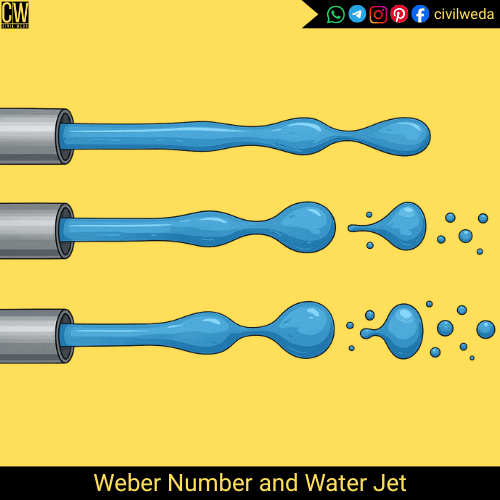
When water exits a pipe or nozzle at high speed, Weber No predicts whether the jet will remain smooth or break apart into droplets. As shown in the figure: - Raindrop and Air–Water Interaction Studies
It is used to understand how raindrops form, how they fall, and when they break into smaller droplets during storms. - Wave Impact and Coastal Engineering
Engineers use the Weber Number to study wave breaking, splashing, and the stability of water surfaces during high-energy coastal events. - Soil Erosion and Rain Impact Analysis
The intensity of raindrop impact on soil depends on the Weber Number, which helps in erosion studies and watershed management. - Bubble Formation and Boiling Heat Transfer
Weber Number helps explain how bubbles form, grow, and detach during boiling processes. - Mixing and Turbulence in Fluid Systems
It is useful in understanding droplet formation during mixing, stirring, and turbulent flow conditions.
In all these areas, the Weber Number provides a simple but powerful way to predict whether a fluid surface will remain stable or break due to motion and force.
Read more Civil Engg Topics
- Portland Cement
- Bulking of sand
- Pile Foundation
- Timber
- Seasoning of Timber
- Types of soil
- Atterberg Limits
- Compass Survey
Conclusion
The Weber Number is one of the most important dimensionless parameters in fluid mechanics. It helps us understand how a fluid surface behaves when exposed to motion, speed, or external forces. By comparing the inertial force with the surface tension, it clearly indicates whether a droplet or water jet will stay stable or break into smaller parts.
From spray systems to hydraulic structures, from raindrop behaviour to wave breaking, Weber Number plays a crucial role in predicting real-world fluid behaviour. Its simplicity and wide usability make it an essential tool for engineers, researchers, and students. Understanding the Weber Number not only improves our knowledge of fluid motion but also helps in designing safer, more efficient, and more reliable engineering systems.
1. What does a high Weber Number indicate?
A high Weber Number shows that inertial forces are stronger. In this condition, droplets stretch, vibrate, and eventually break into smaller droplets.
2. What is the unit of Weber Number?
Weber Number has no unit because it is a dimensionless quantity.
3. What is the typical Weber Number range for droplet stability?
We < 1: Stable droplet
We = 1–10: Deformation but no breakup
We > 10: Complete breakup
Thank You for Reading! 🙏
We hope this article helped you clearly understand the Weber Number in civil engineering. If you found this complete article useful, please share it with your friends and university students. For more informative posts on civil engineering topics, stay connected with Civil Weda. 🚀

