Introduction
In Reinforced Cement Concrete (RCC) design, the effective length or span is one of the most important factors that engineers must consider. It is the span length used for analysis and design, and it directly affects the bending moment, shear force, and structural safety of beams, slabs, bridges, and other members.

If the effective length is not calculated accurately, the structure may become unsafe or uneconomical. To avoid this, the calculation of effective span is clearly defined in IS 456:2000 (Clause 22.2, Page 34). The code provides specific guidelines for different support conditions, such as simply supported, continuous, cantilever, and frame structures.
In this article, you will learn:
- Definition of effective span in RCC
- IS code guidelines for effective length or span calculation
- Effective length or span for different support conditions
- A step-by-step example problem for better understanding
By the end of this article, you will clearly understand what effective length or span is, why it is important, and how to calculate it correctly as per the IS code.
Why do we need to calculate the effective span?
In RCC design, the effective length or span is a critical factor because it directly influences the bending moment, shear force, and deflection values of structural members such as beams, slabs, and bridges. The entire design process of a structural element depends on the span considered. Therefore, calculating the effective span correctly is necessary to achieve both safety and economy.
Importance of Calculating of Effective Span
- Correct Load Analysis
All structural calculations, including bending moment and shear force, are based on the span length. A wrong span leads to inaccurate analysis, which may compromise the strength of the structure. - Ensures Structural Safety
If the span is underestimated, the design may not be strong enough to resist applied loads. If it is overestimated, the member may require excess reinforcement and concrete, making it unnecessarily heavy and uneconomical. - Economical Design
Proper calculation of the effective span helps achieve the right balance between safety and economy. It ensures that the section is neither overdesigned nor underdesigned. - Standardized as per IS Code
The IS 456:2000 (Clause 22.2) clearly specifies how to calculate the effective span under different support conditions. Following these guidelines ensures that the design is safe, reliable, and consistent with national standards. - Represents Real Behavior of Structure
Unlike a clear span, the effective span considers the actual load transfer mechanism, which makes the analysis more realistic and accurate.
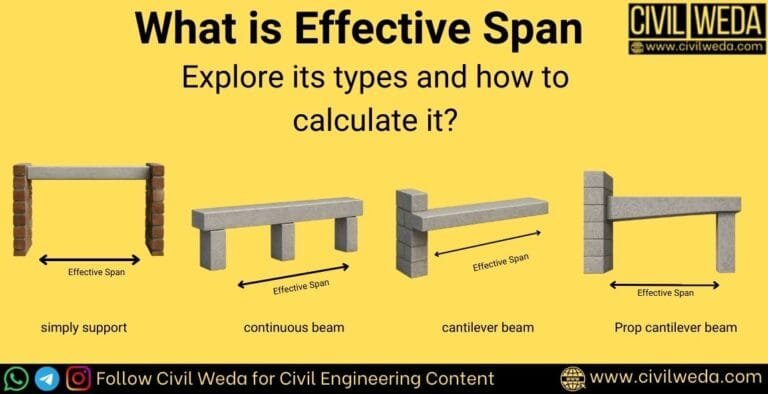
Types of Effective Span
As per IS 456:2000, the value of effective span depends on the type of support condition of the structural member which used in designing. IS 456:2000 provides clear guidelines for effective spans for different support conditions, like the Simply Supported support condition, Continuous support condition, cantilever support condition, and others, which are described below in detail. You can also explore the NPTEL lectures regarding effective length. The strength of the span also depends on the material used. Explore a detailed explanation of cement and its components.
1. Effective span for Simply Supported Condition: Beam and slab

As per IS 456:2000, if a beam or slab is not monolithic (not built integrally) with the supports, then its effective length is calculated as the smaller value of:
- (Clear span + effective depth), or
- (Center-to-center distance of supports).
For example:
A simply supported RCC beam has a clear span = 5.0m, Effective depth = 0.45m, and Width of support = 0.25m; Calculate the effective span of the beam?
Solution:
Case 1:
Effective span = Clear span + Effective depth
= 5.0 + 0.45
= 5.45 m
Case 2:
Effective span = Center-to-center distance between supports
= Clear span + Width of one support
= 5.0 + 0.25
= 5.25 m
As per IS 456, we take the smaller value of both case 1 and case 2.
So, effective span of beam = 5.25 m
2. Continuous Support condition: Beam and Slab
As per IS 456-2000 Effective length or span for continuous beams or slabs depends on the width of the support, and it is calculated as:
(a) When support width < (1/12 of clear span)
When the support width < (1/12 of the clear span), then the effective length should be taken in the same way as for a simply supported beam (Clause 22.2a).
Clear span + effective depth, or the Center-to-center distance of supports, whichever is small.

(b) When support width ≥ (1/12 of clear span) or 600 mm (whichever is smaller)
When support width ≥ (1/12 of clear span) or 600 mm, then the effective span shall be calculated as follows:
(Case1): End span with one end fixed and the other continuous.
Effective span = Clear span between the supports.
(Case2): End span with one end free and the other continuous
Effective span =
(a) Clear span + (½ × effective depth of beam/slab)
or,
(b) Clear span + (½ × width of the discontinuous support)
Take the smaller value of both (a) and (b).
(Case3): Spans with roller or rocker bearings.
Effective span = Distance between the centres of the bearings.
3. Effective span for Cantilever support Condition: Beam and Slab

In the case of a cantilever beam or slab, the effective length or span is calculated as follows:
Normal cantilever beam
In the case of a normal cantilever beam effective length of the beam is calculated as:
Effective span = Length of cantilever (measured up to the face of the support) + half of the effective depth of the beam.
In mathematical terms,
Leff = Length of cantileaver + ½ × effective depth of beam
Cantilever at the end of a continuous beam
When the cantilever forms the end portion of a continuous beam, the effective length is taken as the length measured up to the centre of the support.
Effective length or span of propped cantilever: Beam and Slab

In the case of a propped cantilever beam or slab, IS 456-2000 suggests the effective span is taken as the horizontal distance between the inner face of the fixed support (wall/column) and the inner face of the prop.
In simple words:
The effective length or span of a propped cantilever = Length from the face of the wall to the face of the prop.
For example
Suppose a propped cantilever has, distance between the wall face (fixed end) and prop face = 3.2 m
Then Effective length or span = 3.2 m
Effective Span of Frame Structures
For beams or slabs supported on a rigid frame:
- The effective length or span is taken as the center-to-center distance between the frame supports (for example, the columns).
- However, as per IS 456, this value cannot be less than (Clear span + Effective depth) of the beam or slab.
This condition ensures that the span length considered in design is always realistic and safe.
Example
A beam is resting on two columns of a rigid frame:
- Clear span = 5.0 m
- Effective depth = 0.45 m
- Center-to-center distance between columns = 5.6 m
Now,
- Clear span + depth = 5.0 + 0.45 = 5.45 m
- Center-to-center distance = 5.6 m
Effective length or span = 5.6 m.
Tables for Quick Revision
| Support Condition | Formula for Effective Span |
|---|---|
| Simply Supported | min(Clear span + d, c/c distance of supports) |
| Continuous (narrow support) | Same as simply supported |
| Continuous (wide support) | As per cases 1, 2, 3 in IS 456 |
| Cantilever | Length up to face of support + ½d |
| Propped Cantilever | Distance between the wall face and the prop face |
| Frame Structure | c/c distance of supports, not less than (Clear span + d) |
Read more Civil Engg. Topics
Conclusion
The effective span is one of the most critical parameters in the design of RCC structures such as beams, slabs, bridges, and frames.
A correct calculation, as specified in IS 456:2000 (Clause 22.2), ensures that the structure is safe, durable, and economical.
Key points to remember:
- Always use the appropriate formula based on support conditions.
- Follow the IS code guidelines for national standard compliance.
- Include the effective span accurately in load analysis and reinforcement design.
By understanding and applying the concept of effective span correctly, civil engineers can design structures that are structurally sound and cost-efficient.
FAQs on Effective Span in RCC
1. What is the difference between clear span and effective length or span?
Clear span is the horizontal distance between the inner faces of two supports.
Effective span is the span length used for analysis and design, which considers the actual load transfer mechanism.
Generally, the effective span is slightly larger than the clear span.
2. Why is effective length important in RCC design?
The effective span directly influences the bending moment, shear force, and deflection of structural members like beams and slabs. A wrong calculation can make the structure unsafe or uneconomical.
3. Which IS code specifies the calculation of effective length?
The calculation of effective span is defined in IS 456:2000, Clause 22.2.
It provides guidelines for different support conditions, such as simply supported, continuous, cantilever, and frame structures.
4. How do we calculate the effective length for simply supported beams?
As per IS 456:2000, for a simply supported beam or slab that is not monolithic with the support, the effective span is the smaller of:
(Clear span + Effective depth), OR
(Center-to-center distance of supports)
5. What is the effective length of a cantilever beam?
For a cantilever beam,
Effective span = Length of cantilever up to the face of the support + ½ × Effective depth of the beam.
6. What is the effective length for a propped cantilever?
For a propped cantilever,
Effective span = Horizontal distance between the inner face of the fixed support and the inner face of the prop.
7. Does the effective span affect the quantity of reinforcement?
Yes, since bending moment and shear force depend on span length, an incorrect effective span calculation can lead to more or less reinforcement, affecting both safety and economy.
Thank You for Reading! 🙏
We hope this article helped you clearly understand the Effective Span in civil engineering. If you found this complete article useful, please share it with your friends and university students. For more informative posts on civil engineering topics, stay connected with Civil Weda. 🚀